Posts RSS Comments RSS 1,344 Posts and 163 Comments till now

Archive for July, 2007

Dawn, Sierra Nevada and Mono Lake

Dawn, Sierra Nevada and Mono Lake

Dawn, Sierra Nevada and Mono Lake. Mono Lake, California. July 23, 2007. © Copyright G Dan Mitchell.

Photographed in July of 2007 on a beautiful, still morning as the first sun hit the highest peaks of the Sierra Nevada on the eastern border of Yosemite National Park.
keywords: dawn, sierra, nevada, mono, lake, sunrise, reflections, clouds, lee vining, tufa, towers, plant, shoreline, california, usa, landscape, travel, scenic, stock, yosemite, shoreline, shore, water

How About That 5D?

Jim writes:

I have been viewing your blog for the past six months and love your work.

Currently, I am using a Rebel XT and thinking about moving up to a 5D and I noticed you just did. What’s your take on the 5D? Is it worth the extra weight in lugging around the trails and is there anything you prefer on the XT when compared to the 5D.

Thanks, Jim.

That can be a more complicated question than might be apparent at first. I really do like the 5D for its greater dynamic range, greater ability to capture fine detail, good wide angle performance, and ability to use f/11 and f/16 without diffraction issues.

That said, there are also good arguments for the smaller crop sensor cameras including the XT or the newer version, the XTi - especially if you are photographing on the trail. These cameras are certainly lighter and smaller and can use smaller and lighter lenses to capture the same angles of view. They can also produce fine images if you use good lenses and good shooting technique. I regularly made 13 x 19 prints from my XT and successfully printed up to 16 x 24. If you don’t print larger than this, the size and weight advantages of the crop sensor cameras may trump the other advantages of the full frame bodies.

Another factor may be which lenses you currently own. If you have a crop body but no great lenses yet, it can make a lot of sense to upgrade lenses first, with an eye to developing a set that will work with your future full frame camera. While DSLR bodies have a fairly short life span these days, good lenses will last - and they’ll improve your photographs on the both the current and future cameras.

In the end the decision between crop and full frame camera bodies is a personal one. For me it is worth the extra size and weight but that may or may not be the case for others.

Dan

Morning, Lake Ediza

Morning, Lake Ediza

Morning, Ediza Lake. Sierra Nevada, California. July 25, 2007. © Copyright G Dan Mitchell.

Visiting the Racetrack Playa

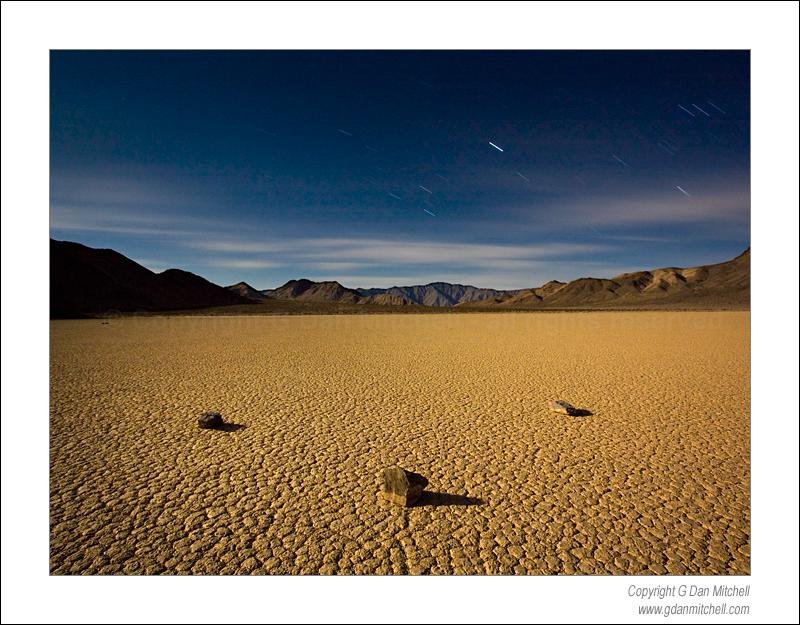
Three Rocks, Moonlight - Racetrack Playa

Three Rocks, Moonlight - Racetrack Playa. Death Valley National Park. March 2, 2007. © Copyright G Dan Mitchell.

I just got a “Flickr Mail” from John:

Noticed you had some recent photos of The Racetrack in Death Valley. I was in the area and tried to get there from the south, but the road was too rough for my rental car. Was wondering if you got there via the dirt path from the north, or from the south? Wondering if the north road is any better…

Thanks for writing, John. Yes, the Racetrack is an amazing and very beautiful place!

All access to the Racetrack is via some pretty rough dirt/gravel roads. The most popular approach comes in from more or less the north. From near Scotty’s Castle, take the short paved road to the Ubehebe Crater area. Near the Crater there is an intersection where the gravel road heads off towards Teakettle Junction and eventually the Racetrack.

The distance to the playa via this approach is something like 27 miles. Every time I have driven there portions of the road have been very badly washboarded. While a few (maniacal?) drivers simply go faster in these conditions, I slow down. So it takes me a couple hours to work my way out to the south end of the playa.

About this road, I believe that the official Park Service recommendation says something along the lines of “recommended for four-wheel drive, high clearance vehicles.” As long as the weather is good - and you don’t try to drive too fast - I think that the “clearance” part of this is more important than the 4WD part. I’ve driven it in a 4WD Dodge Durango and my current AWD Subaru Outback. Although I wouldn’t want to try it and I certainly don’t recommend it, I have seen minivans and even sedans out there.

I have not driven in from the south approach that I think you are describing. I have heard that portions of that road are more difficult than the standard approach, though this past season one visitor told me (though I cannot verify it) that it isn’t as bad as it used to be - supposedly it is wider now that Park staff are driving Hummers (the macho military version) on the back country roads. Count this as a mere rumor.

There is a small official camping area a mile or two south of the playa, though it is little more than a couple turn-outs and a crude pit toilet. There is no drinking water here or anywhere else on or near the playa. I have camped there, though many people seem to sleep in their vehicles in one of the parking areas at the playa.

Most of the moving rock photos you have seen were likely shot at the south end of the playa. From the parking area walk perhaps 10-15 minutes out onto this end of the playa and you will begin to encounter the rocks, which seem to originate from a rocky hill at the south end of the playa.


The Source. Death Valley National Park, California. April 3, 2007. © Copyright G Dan Mitchell.

There are other things to photograph on and around the playa. “The Grandstand” is a marvelous rock structure out in the middle of the playa - you’ll see it clearly as you approach. This can be an interesting feature to photograph in the late afternoon before the best light for photographing the moving rocks at the sound end.


The Grandstand, Racetrack Playa. Death Valley National Park. April 2, 2007. © Copyright G Dan Mitchell.

The mountains around the playa are also quite beautiful in the early and late light, especially if you are fortunate enough to be there when there are clouds.

Crossing Tracks, Racetrack Playa. Death Valley National Park. April 4, 2007. © Copyright G Dan Mitchell.

If you are going to the trouble of driving nearly 60 dirt road miles to the playa, do plan to be there for sunset and sunrise. I almost feel sorry for folks who spend 4 hours driving this road, only to spend an hour or two there in the harsh midday light. Another hint: if you are a night photographer, spend some time during the day locating interesting features and then return to the playa after dark on a full moon night.


Moving Rock, Moonlight, Racetrack Playa. Death Valley National Park, California. April 2, 2007. © Copyright G Dan Mitchell.

It probably goes without saying, but I’ll say it anyway - this is not a place you’ll want to go in the summer. My visits have all been in early April and even then it can be quite hot and dry. On the other hand, I’ve seen light snow out there as well. Be prepared for a wide variety of possible conditions. I’d like to go earlier in the season sometime, and I hear that winter is also good.

Conditions can change quickly out there. Depending upon the time of year and the current situation you could see hot and dry weather, snow, high winds, or even flash floods. I urge all visitors to check on current conditions with Park Service personnel before heading out to the playa or any other back-country areas of Death Valley.

I hope you get out there soon and come back with great photographs!

South Tufa, Dawn

South Tufa, Dawn.

South Tufa, Dawn. Mono Lake California. July 23, 2007. © Copyright G Dan Mitchell.

Yosemite Photographs at Stanford

The Cantor Arts Center at Stanford University is hosting a show of photographs from Yosemite through October 28. It features photographs by a number of classic photographers including early Yosemite photographers like Carleton Watkins, Eadweard Muybridge, George Fiske, and of course Ansel Adams. More information at museum.stanford.edu.

Pelicans in Flight, San Francisco

Pelicans, San Francisco

Pelicans in Flight. San Francisco, California. July 15, 2007. © Copyright G Dan Mitchell.

Palace of Fine Arts, San Francisco

Palace of Fine Arts, San Francisco

Palace of Fine Arts. San Francisco, California. July 15, 2007. © Copyright G Dan Mitchell.

Column, Person with Bag - Palace of Fine Arts

Column, Person with Bag - Palace of Fine Arts

Column, Person with Bag - Palace of Fine Arts. San Francisco, California. July 15, 2007. © Copyright G Dan Mitchell.

Bad Advice - Part 1

I follow online photography forums enough that I recognize certain topics that come up with great frequency. Among them is the question: “What should be my first lens?” (There are variations: “What is the best lens?” for example.) Many posting this question have acquired an entry-level cropped-sensor DSLR like the Canon 400D/XTi, a fine little DSLR. (You can get an idea of my view on this camera by reading an old post of mine: Why I Chose the Canon 350D/XT.)

Among the standard answers to this type of question, one goes something like this: “Just pick up the Canon 50mm f/1.8 lens.” There are variations. Some writers also suggest that using only a prime lens (rather than a zoom) will teach more about composition. Many point out that the lens is both quite sharp and quite cheap.

It is sharp. It is cheap. But as advice to beginning DSLR photographers, this is among the worst.

Yes, the 50mm focal length used to be regarded as “normal.” Back in the days of 35mm film SLRs many people did start out with just such a lens. And the Canon 50mm f/1.8 is a fine little lens, optically speaking, at a remarkably low price. If you look around a bit you can pick one up for $75 or less.

But it is still the wrong choice for almost all new DSLR photographers. Why?

  • Several decades ago nearly everyone started out with a prime lens (or two) rather than a zoom. But at that time the quality of the zooms - at least those that were affordable - was not very good. Maximum apertures tended to be small, and before high ISO DSLRs this was a big problem. It wasn’t necessarily the case the primes were better photographic tools, but they were pretty much the only option for most new photographers. Today decent and even excellent zoom lenses are available at costs that are quite reasonable.
  • Leaving aside the availability of decent zoom lens options, even if you wanted a “normal” prime it would not be a 50mm lens. Nearly all DSLRs (and all entry level DSLRs) use cropped sensors that are smaller than a 35mm film frame. Because the smaller sensors pick up a smaller angle of view from a given focal length lens, one typically uses shorter focal length lenses on the crop sensor bodies. The old-school “normal” 50mm “standard” lens provides the narrower field of view that an 80mm “portrait lens” would have provided on a 35mm film camera. To get the same so-called “normal” field of view that the 50mm lens provided on the older cameras you would use a 31mm lens on a modern crop sensor DSLR. Bottom line: If you want to replicate the old “50mm normal” lens on a crop sensor camera body, an actual 50mm lens is the wrong lens. A more comparable “normal” prime might be something in the 24mm, 28mm, or 35mm range.
  • Some claim that using a fixed focal length lens makes you a better photographer. I have a couple problems with this idea.
    • First, and most practically, most buyers of entry-level DSLRs do not aspire to careers as professional fine art photographers. They want to get decent quality photographs of friends and family, and of their experiences. For them the versatility of a decent zoom makes it a much better choice than a prime in nearly all cases. In fact, most of them will probably be quite happy with the standard (and virtually free) “kit zooms” that come with the cameras - such as the Canon EFS 18-55mm f/4-5.6.
    • Second, I don’t buy the idea that using a prime necessarily does make you a better photographer or necessarily teach composition more effectively. Good composition is the result of a number of factors including, but not limited to, the following: finding an interesting combination of picture elements, determining a shooting angle that places them in an interesting and effective arrangement, figuring out how to best locate them within the frame, using subject/camera distance and focal length to control the relationships among the elements, and using depth of field appropriately. What quicker way to learn about the effects of different focal lengths than by using a lens that provides them? With a zoom one can readily experience how different focal lengths affect the final composition. I have nothing against prime lenses - I do use them - but I think that primes can slow down the learning process, not zooms.

So, if that 50mm prime is not the right place to start, what is?

In my view, the true beginner (using a Canon crop sensor DSLR - I’m not familiar with the options from other brands) can be well served at first by the inexpensive and decent 18-55mm EFS kit lens. The cost is next to nothing, it covers a pretty useful basic range, optical quality is fine for starting out. By using this lens, the beginner can learn a lot about photography - and begin to discover what his/her photography may require in terms of other lenses for future purchase.

If one is determined to start out with a “normal prime lens” on these cameras, there are more appropriate options. While they are not too expensive, they will cost more than the 50mm f/1.8 - but they do have the significant advantage of being more useful lenses for most people. Some examples from Canon include the 35mm f/2, the smaller aperture 28mm lenses, or even the 24mm f/2.8.

With all that said, what is the use of the 50mm f/1.8? There are several, and among new photographers starting out with the kit zoom, for some one of the 50mm primes will eventually make sense. The f/1.8 version is an inexpensive and fine little “portrait” lens for crop sensor cameras for beginners whose interests run in that direction. It can also be very useful in certain types of indoor, low light photography, for example concert and theatrical photography. I can imagine other uses, too.

But just not as a starter lens for a crop sensor DSLR user.

Next »