
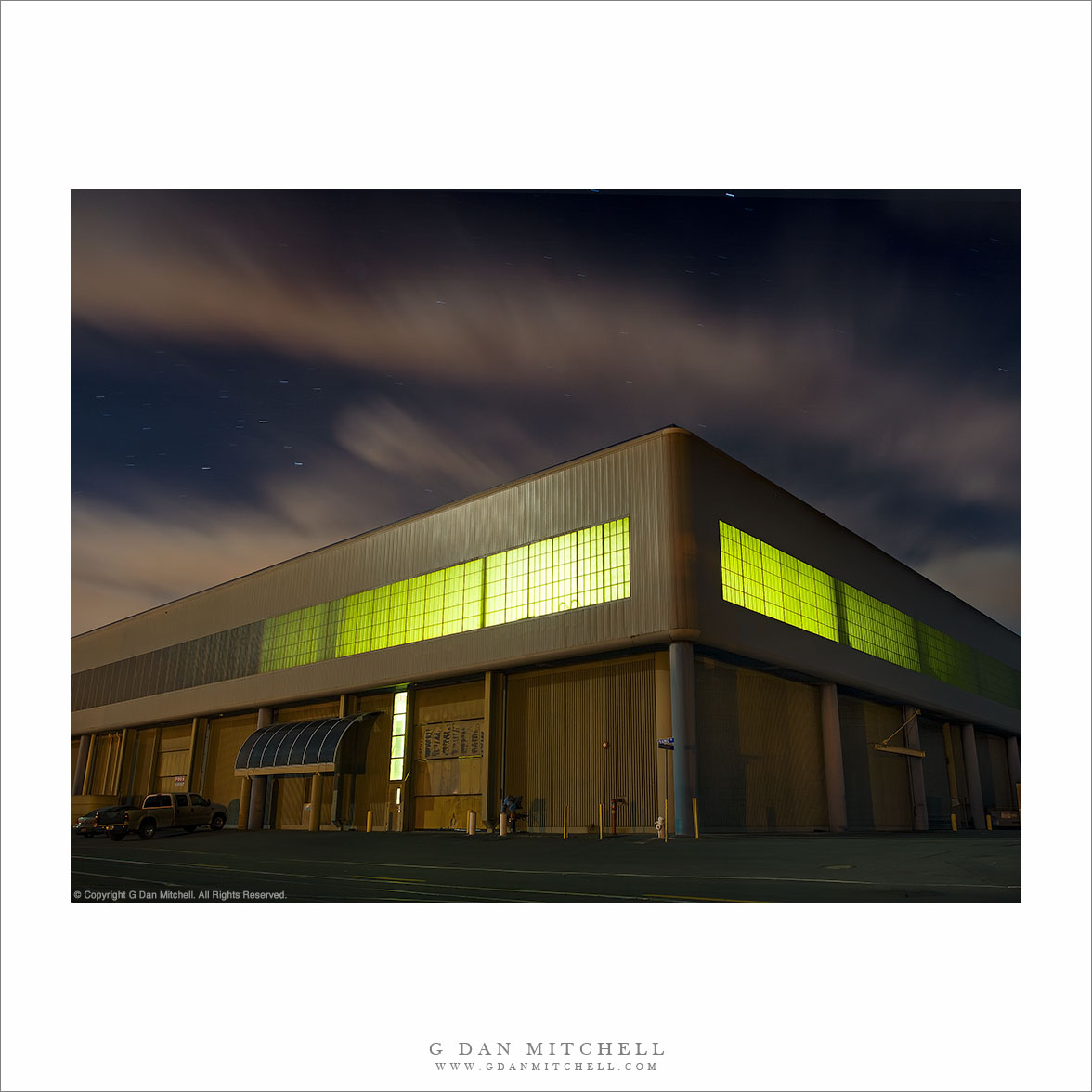
A reader wrote and asked how I determine exposure times for night photography, and I decided my answer so that others can see it. Once I started writing, I decided to go ahead and share more basic techniques that can be very useful for night photography, too — including things like focus, etc. This isn’t a comprehensive coverage of the subject, but it does touch on a few key ideas.
First, for information about the techniques of nocturnal photography (and for some great examples of the photographic results and for workshop opportunities) I recommend a visit to the web site of The Nocturnes, the San Francisco Bay Area night photography group more or less run by Tim Baskerville. I’ve joined them on many night photography shoots, and the resources at their web site provide a ton of basic information that will save you many frustrating nights of trial and error. (I’m a member of a related group, Studio Nocturne SF, a collective of photographers who do night photography and exhibit as a group.)
Since so much of the basic information is available there, I’ll just add a few techniques and ideas that I find useful, especially for shooting with DSLRs. Here they are, in no particular order.
Consider using your camera’s long exposure noise reduction system — On my Canon DSLRs this setting causes the camera to make a second “dark frame” exposure following your “real” exposure. You might be tempted to forego this option since it doubles the time required for each exposure – your 60 second exposure will be followed by a 60 second dark frame exposure, while you stand there and twiddle your thumbs. (Or, do what I do – start composing your next shot.) DSLRs are subject to increased noise and “hot pixels” with very long exposures, but the dark frame provides the camera’s software with a reference that contains only the noise and hot pixels, and it can use this to map out (or subtract) the noise, etc from the image.
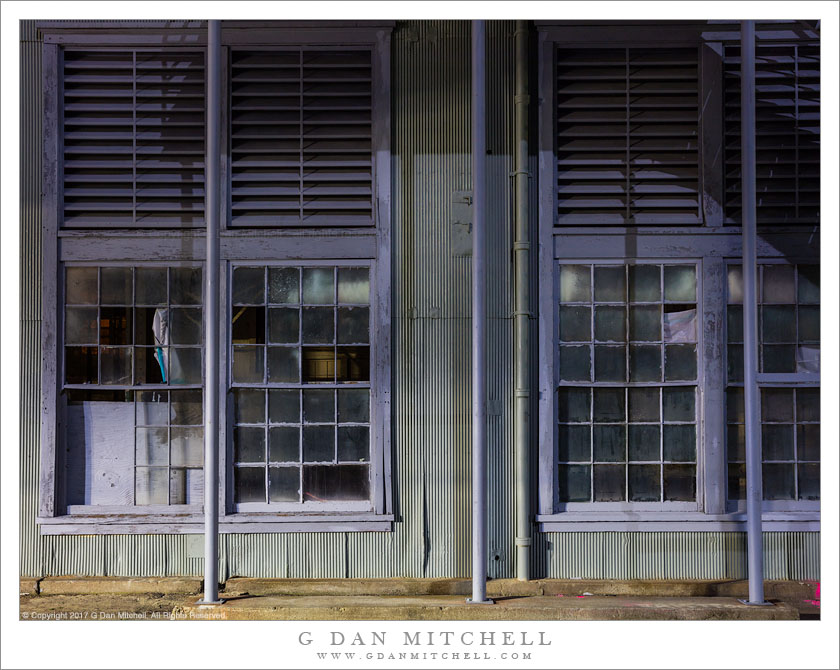
(Experiment with your own camera to discover the exposure lengths that benefit from the use of this setting. Modern digital cameras are less susceptible to noise issues than these cameras used to be. Some of the most recent digital cameras will not really need to use this feature much, if at all.)
Rely on your histogram to check exposure — do not rely on how the shot looks in the display. If the shot looks like what you see at night, in most cases it will be way underexposed — and, as a result, you’ll have a very noisy image and you may end up with artifacts like noise and banding. Instead, use an exposure that produces a balanced histogram curve — or, “expose to the right,” as many of us like to say. Your exposure may look brighter than the scene looks in person, but you can darken things in post and thus reduce visible noise even further. With many subjects, a well-exposed night photograph will look just as bright as one made in daylight.
Shoot wide open at high ISO to calculate basic exposure – If you have a f/1.4 lens and can set your camera to ISO 3200 or higher, do so. Let your camera make an automatic exposure and use that as a starting point. For example, if you get a decent (though noisy and otherwise awful looking) exposure at ISO3200, f/1.4, and 1 second you can work backwards from there to get a better exposure. Switching back to ISO 100 means that you need 5 stops more light, so your exposure time will go from 1 second to 32 seconds. (Count 1, 2, 4, 8, 16, 32.) Changing your aperture back to a more reasonable f/8 means another 5 stops or about a 17 minute (!) exposure – if my quick calculations are correct. (Update: I understand that if you can do this at ISO 6400 you can do a straight conversion from seconds to minutes – e.g. if the exposure at some aperture is 1 second at ISO 6400 the claim is that it will be 1 minute at ISO 100 at that same aperture.)
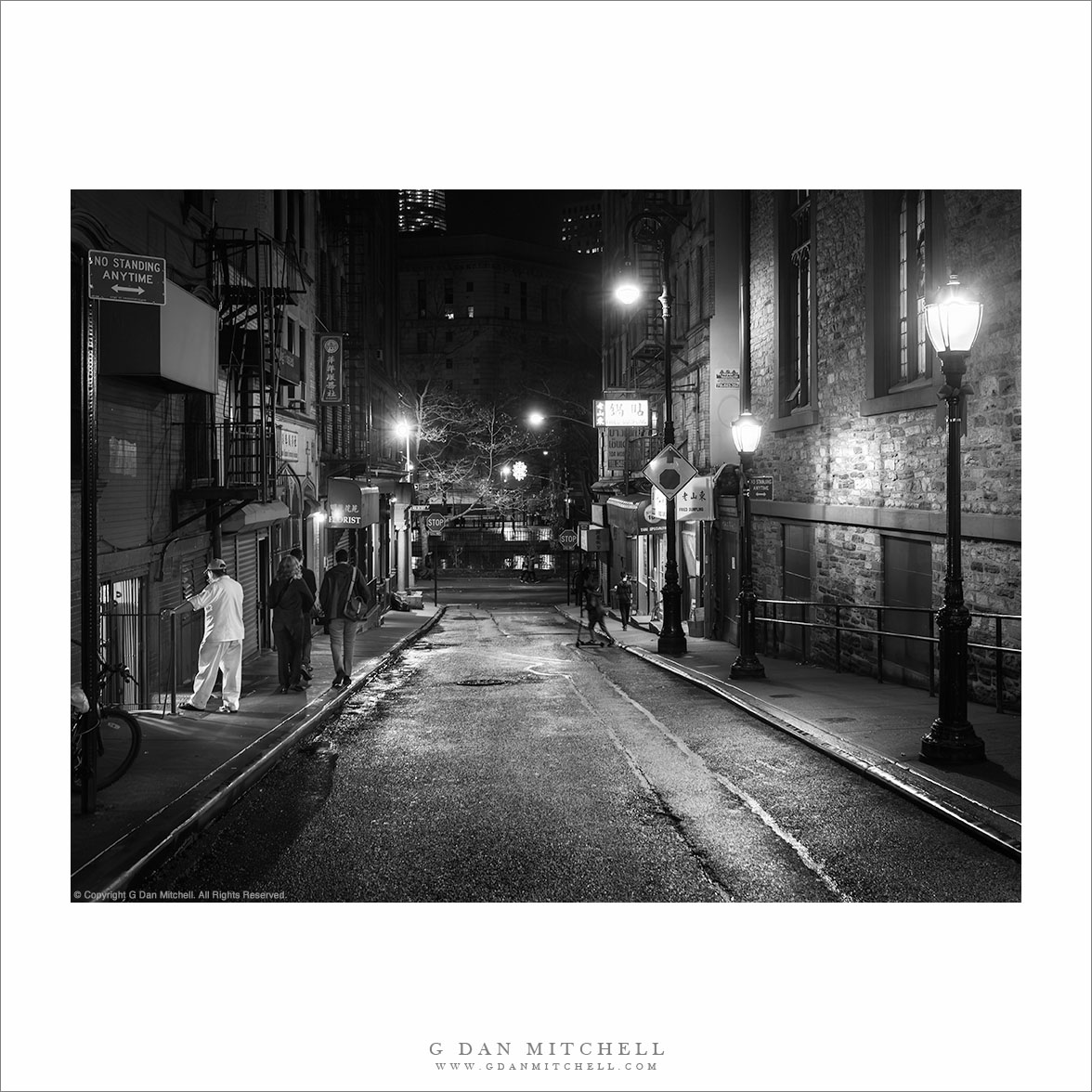
Apertures and ISOs that work in the daytime are good starting points for long exposure night photography — If f/8 at ISO 100 is your preference for daytime landscapes, then there is a good chance that these will be about right for night time landscapes as well. It just takes longer — sometimes a lot longer. If you are shooting a subject that would use larger apertures and smaller DOF in the daytime, you can probably use similar apertures at night. (This advice is mostly intended for those shooting from the tripod. When shooting handheld in very low light you may have no choice but to use a large aperture and a higher ISO. Fortunately today’s cameras are very good performer at higher ISO values, and some post-processing noise-reduction will usually produce a good image.)
Find something to focus on — Getting good focus stymies many night photographers. There are several approaches that you can try, and the right choice will vary depending on the shot.
- If there is a relatively bright spot in your composition – perhaps a light bulb, a reflection, the moon, etc. — place an autofocus point right on top of it and see if it will acquire focus. Then switch AF off and recompose the shot if necessary.
- Sometimes there is nothing in the scene that will provide enough light/contrast for autofocus to work. Look around for something outside of your composition that is about the same distance away — focus on that, switch AF off, and recompose.
- Temporarily place a light in the scene — a bright flashlight or your smartphone will work — and focus on it.
- You may be able to create a usable focus point by shining a laser pointer beam into the scene and focusing on it. Sometimes a bright enough handheld light or flashlight will be enough.
- If you have one “must work” shot to make and plenty of time, you could set up the shot and determine focus during the daylight and leave the camera in position for your night exposure. (A potential focus shift due to temperature changes is real but likely inconsequential.)
- Manual focus may be a possibility – either by trying to get a point light source such as a bright star (or your laser pointer, or a light placed in the scene, etc.) to focus manually through the viewfinder or by relying on the distance scale on the lens barrel.
- Since perfect focus may be more elusive at night you have another reason to consider smaller apertures with their greater depth of field — they are a bit more forgiving of less-than-absolutely-perfect focus.
- If your camera has a “live view” feature, you may be able to manually focus in light light levels at which neither AF nor traditional manual focusing will work – highly recommend for night photography work! See the exposure simulation feature on your camera.
With very long exposures, precise exposure time is less critical than you think — When shooting in the daytime very small changes in absolute exposure time make a bit difference. If you shoot at 1/100 second, increasing the exposure time to 1/50 second doubles the exposure. But at night things are a bit looser. If you are making a 6 minute exposure, you’d have to be off by six minutes to double the exposure or by three minutes to cut it in half. With that in mind, a few seconds hardly matter at all. I don’t bother with automated timers. I just count seconds (or chimpanzees, or hippopotamuses, or whatever…) or use my watch. That said, if you do have a timer you can probably let your mind wander a bit more while you enjoy your nighttime surroundings during the long exposure.
Daytime exposure tricks often work just as well at night — When photographing high dynamic range scenes during the day I may make two exposures — one for shadows and one for highlights — and use masks to combine them in post. The same situation often arises at night, especially if you have a shot that includes dark areas and bright artificial light sources. You may need to make one exposure that gets some detail from the shadows and a second that avoids blowing out the bright light sources.
Lens hoods are extra important with night photography — That may seem completely counter-intuitive, but when shooting at night you often have light coming from many more directions than when you shoot in sunlight, and the potential for flare increases. (You also may be a bit more likely to bump your lens into something, and the hood offers some physical protection.)
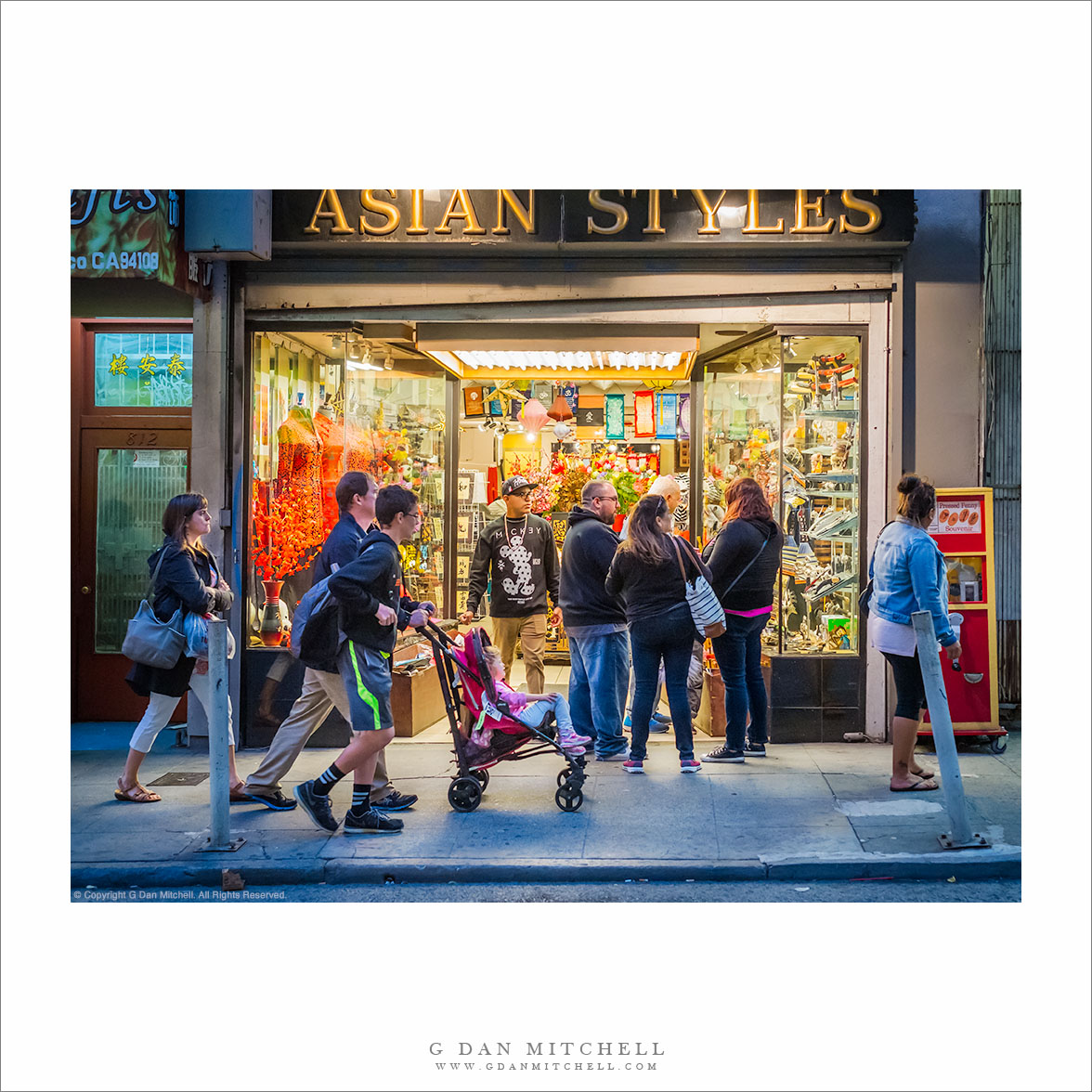
Try shooting handheld — While most night photography is going to require a tripod, modern digital cameras often work effectively enough at high ISOs that you can shoot many subjects without a tripod. For example, I now do almost all of my urban night photography handheld, shooting with relatively large aperture prime lens at ISO1600-6400 or even higher.
Try a small mirrorless camera — For some kinds of night photography, such as my night street photography, a small digital camera can be ideal. For one thing, the small cameras are often unobtrusive and less likely to draw attention to you. Many of them work very well at high ISO settings, and all ow you to shoot handheld in typical urban environments. Their electronic displays can often give you a usable view of your scene even in extremely low light.
That’s a quick list. Hope you find it useful! Have a question or something to add? Leave a comment below!
(By the way some of my night photography is found here and other posts related to night photography are on this web site.)
(Revisions: April 21, 2017; March 8, 2018; December 18, 2018 July; July 2019.)
G Dan Mitchell is a California photog
Leave a comment or question using the form. (If you are reading this on the home page, click the article title to see the full article and the comment form.
G Dan Mitchell is a California photographer and visual opportunist. His book, “California’s Fall Color: A Photographer’s Guide to Autumn in the Sierra” (Heyday Books) is available directly from him. Blog | Bluesky | Mastodon | Substack Notes | Flickr | Email
All media © Copyright G Dan Mitchell and others.
nd others as indicated. Any use requires advance permission from G Dan Mitchell.
Thanks! great info! Well researched!
Southern Hello great ideas for my night theme photos this evening …
We have some on Picasa sites here also.
https://picasaweb.google.com/grannie.oakley
https://picasaweb.google.com/jtc.plumcreek
And on our free website: http://cappelscandids.weebly.com/
These are shot through a thermopane window with storms on it so 3 layers of glass to keep clean enough for shooting. Then we put Rain X on the outside of the storm window so we can sorta shoot through the rain that is supposed to run off of it. I am a real chicken to be outside in that weather…. Guess the time, start with f4 to f32, iso 100 and from a minute to 40 minutes depending on brightness focused at infinity. Never tried the histogram, we just lock the shutter and wait. Ya go through batteries as the camera is running all the time. With our film cameras from yesteryear, we pulled the batteries out of them to shoot it. Fun playing from inside the house..
Thanks Dan. May have to try regular photographs at night besides our lightening shooting. We do it almost opposite for lightening, so will have to play on a good night, not during a bad storm. Thanks for the well written information.
Thanks, Jon. Glad you enjoyed it. Funny, for all the “regular” night photography I do, I have never shot lightening…
Dan
Thanks Dan,
thanks for taking the time to post this. I will try this and see what happens.
Kind Regards, Rich
Good point, Nancy. I rely on that technique all the time, but hadn’t thought of adding it to this post.
Dan
Dan – here is another trick for getting the night exposure right on cameras with LiveView (or at Canon Cameras with LiveView). Turn on LiveView and click the “Info” or display mode button until the camera displays the histogram over the top of the image on the back of the camera. As you adjust the exposure, just watch the histogram. This wprks on my Canon 5dMKII works and ALSO on my (now old) Canon G9.
well written and informative…you just might inspire me to go out at night to see what I’ve been missing.
C’mon over to the “dark side” – it is fun!
Dan
Glenn, I usually have my camera set to automatically invoke LENR on long exposures so, yes, I do use it when using my 9-stop ND filter.
Dan
Excellent article Dan.
Had a talk at my local camera club by a photographer who does low light/night photography and he recommended the long exposure noise reduction as well. Actually I wonder if it’s worth using this feature if you’re using some like a 10 stop ND??
Hi, Jeff. I have less experience shooting events like the Dia De los Muertos parade than with shooting stuff from tripods – but judging from your photos I might have to shoot this, too, next year! Cool photo opportunities for sure.
The questions of whether to use a f/2.8 zoom with IS or a prime with a larger aperture is one of those “six of one, half dozen of the other” issues. If your issue is mainly blur due to camera motion, the IS should in theory get you more low light ability than the primes. (2-3 stops or more on that lens if I recall correctly.) On the other hand, if the issue is subject motion – which seems like it might be a concern with an event like this – then the larger apertures will help you control that in ways that aren’t possible with the IS-equipped zoom. And, as you suggest, the weight/bulk issue is not trivial, especially in these shooting conditions. (And, of course, shooting at 200mm on a cropped sensor in low light is really pushing it – this is the equivalent of shooting a 320mm lens on full frame, which might typically require a 1/250 or faster shutter speed!)
If I can shoot the zoom for an event like this, I think I’d prefer its versatility – but if you are mainly shooting faces (as in many shots at the link) you might get by with the 85mm prime wide open. I’d go ahead and bump the ISO a bit if necessary. You’ll get a bit more noise, but at some point you have to choose between motion blur and noise – you’ll get one or the other.
Basically, this kind of shooting is just plain difficult. You have a sort of three-way conflict between need for DOF (not much of that in a long lens at f/1.8), low noise, and the ability to stop motion. In general, I think I’d accept some noise in order to retain sharpness in many cases.
A few other tricks can help. Using a monopod is one possibility. In some cases you can also brace yourself or even the camera against a wall or a pole.
Dan
Good stuff Dan! Looking forward to exploring the “night scene” a bit more myself (rough with a family, but one can always dream, right? :-)
One specific question though if you don’t mind. Shot last year’s Dia De los Muertos parade in SF, and had a blast. Reasonably happy with what I shot, but thinking of possible improvements for this year (assuming I can go). Last year was with the 40d, and the 70-200 2.8ISL wide-open at 1600 (I think , or possibly “H” for a few).
http://www.jmoodyphoto.com/simpleviewers/Muertos/index.html
Some camera shake blur on some (that lens gets heavy after a while), and a little too much ‘noise’ as well on many (though I don’t post process all that well, and that might make a difference).
Am currently toying with the idea of either an 85mm 1.8, or a 50mm (though I’ve never really used a prime) in order to drop the weight, and add a stop of light. Do you think that I’d be likely to get noticeably “cleaner” shots from either of those lenses (assuming an equally steady or not steady hold), or…? The 85mm sounds good to me for the length (many of the gallery ones are fully extended to 200mm or close to it), but the DOF issue of shooting wider than 2.8 also scares me a little. Thanks!~
Dan,
Thanks for the tips! I’m new to the night stuff, so I’ll use these tips to get myself moving in the right direction!
Thanks, and good luck with your night photograph. (Another source of night photography info is The Nocturnes web site.)
Dan
Great tips! Thanks for taking the time to put these together and for sharing them!
Dan, this is a great article. Thanks!
Very useful guide, Dan. Appreciate your lengthy response and tips. If not for the rainy weather in San Jose today, I’d use some of them to experiment tonight in my back yard. Maybe it won’t rain too bad.
Thanks again – these open up plenty of new ideas for the next time I’m out shooting.