
Posts RSS Comments RSS 2,443 Posts and 1,533 Comments till now

Archive for January, 2010

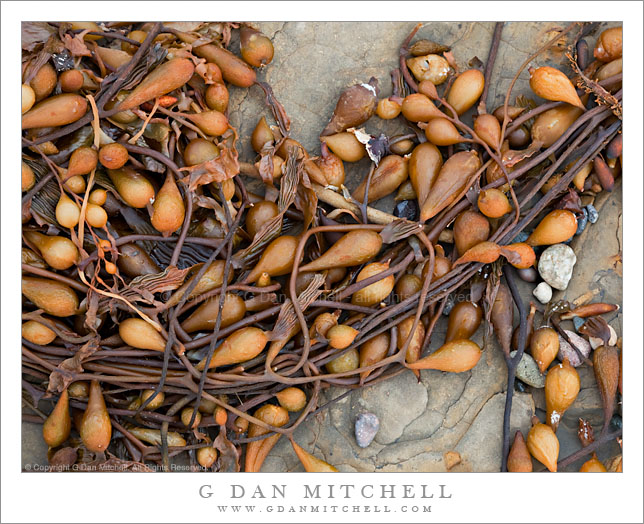
Kelp Detail #1, Weston Beach

Kelp Detail #1, Weston Beach

Kelp Detail #1, Weston Beach

Kelp Detail #1, Weston Beach. Point Lobos State Reserve, California. January 18, 2010. © Copyright G Dan Mitchell – all rights reserved.

Detail of kelp and other debris (“wrack”) washed up by winter storms at Weston Beach, Point Lobos State Reserve, California.

This is another of the close up shots of kelp washed up on the shore at Weston Beach following a winter storm. There are several things that caught my eye on this pile of washed up sea trash… ;-) First, the shapes and colors of the kelp “floats” are intriguing, and I think more photogenic during this wetter time of year. I also liked the curving steps of the plants that wind through the frame from the left and up toward the right. Mixed in with this are some larger leaves with deeply ridged texture. Underlying all of this is the faintly colored sandstone and a few odd colorful stones.

This photograph is not in the public domain and may not be used on websites, blogs, or in other media without advance permission from G Dan Mitchell.

G Dan Mitchell Photography | Twitter | Friendfeed | Facebook | Facebook Fan Page | Email

keywords: kelp, plant, rock, pebble, sea, ocean, life, nature, washed, up, storm, debris, wrack, winter, point, lobos, state, reserve, park, california, usa, monterey, carmel, peninsula, pacific, pattern, brown, red, orange, yellow, rock, sandstone, landscape, detail, close, up, stock
Web Publishing Experiment – Draft of the Next Death Valley Post

I decided to try a little web-publishing experiment with part 2 of my series of posts on photographing Death Valley National Park – I’m sharing the draft publicly as I write it. I decided to try this for several reasons.

  • It is prime DeVa photography season now and for the next couple of months, and some people may find the information useful before I’m ready to release the final version.
  • There are lots of you who have DeVa experience of your own, and perhaps your comments and feedback may improve the post.
  • Maybe, just maybe, someone might be interested in watching the evolution of the post. I can flatter myself, right? :-)

To find out more take a look at the current version of the draft, where I’ve added a few words of explanation.

Dan

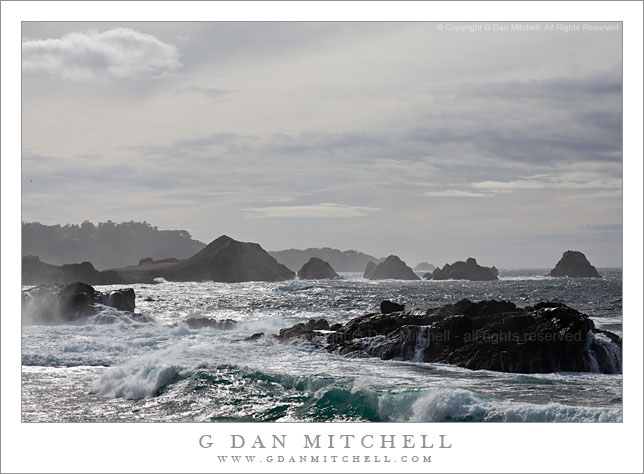
Bird Island from Weston Beach

Bird Island from Weston Beach

Bird Island from Weston Beach


Bird Island from Weston Beach. Point Lobos State Reserve, California. January 16, 2010. © Copyright G Dan Mitchell – all rights reserved.

Photograph from Weston Beach of wild winter seas near Bird Island and surrounding rocks along the California coastline at Point Lobos State Reserve as high clouds from an approaching winter storm begin to spread across the sky.

Since I decided to make this short mid-January visit to Point Lobos on the spur of the moment (after discovering that predicted rain was going to arrive later than expected) I had no idea what the tide conditions would be like. It turned out that the tide was in when I arrived and familiar locations like Weston Beach, the location from which I made this photograph, were fairly inundated by the tide and the high surf from the approaching weather front. So rather than trying to shoot the smaller details of the beach/cove – I saved that for later in the day – I decided to see what I could do with the longer views of the huge surf and the backlit haze and light fog that emphasized the rocks and bluffs receding into the distance. The light was very changeable, and the sky in this image explain why – for the most part there was a thin layer of high clouds, but there were also scattered thicker clouds that cast moving shadows across the water.

This photograph is not in the public domain and may not be used on websites, blogs, or in other media without advance permission from G Dan Mitchell.

G Dan Mitchell Photography | Twitter | Friendfeed | Facebook | Facebook Fan Page | Email

keywords: weston, beach, cove, bird, island, rock, sea, stack, ocean, shore, cliff, big, sur, point, lobos, state, reserve, park, winter, california, usa, carmel, monterey, peninsula, pacific, season, sky, clouds, spray, wave, surf, chop, wild, bluff, landscape, nature, scenic, travel, seascape, stock

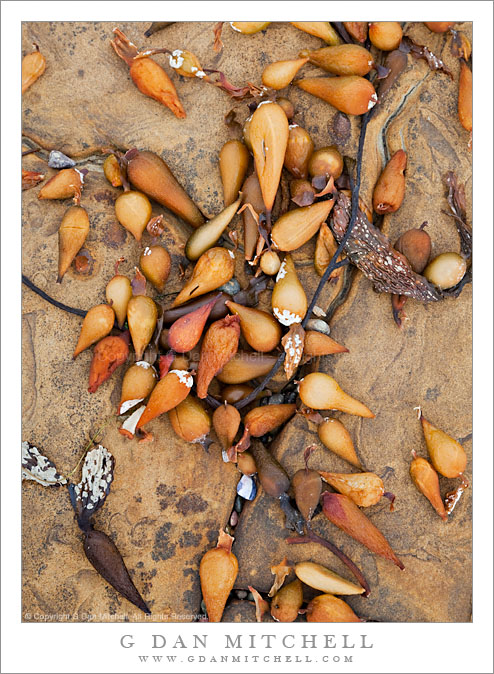
Kelp Detail #2, Weston Beach

Kelp Detail #2, Weston Beach

Kelp Detail #2, Weston Beach

Kelp Detail #2, Weston Beach. Point Lobos State Reserve, California. January 16, 2010. © Copyright G Dan Mitchell – all rights reserved.

Detail of kelp and other debris (“wrack”) washed up by winter storms at Weston Beach, Point Lobos State Reserve, California.

Perhaps putting more trust in the words of the weatherman than was appropriate, I slept in on this morning, having heard the night before that it was going to rain. But when I got up the sun was shining, and I realized that I should have been out shooting! After taking care of a few morning chores, I managed to get away and drive down to the coast. I didn’t have a specific plan besides “the coast,” but as I drove I kept an eye on the sky since the weather from was starting to come ashore and high clouds were beginning to diffuse the light.

As I got near Monterey I figured I might as well take a look at Point Lobos, even though it seemed like the clouds might be starting to build along the coast – I figured that if it turned out to be too cloudy there I could just come back by way of Moss Landing. At Point Lobos the seas were fairly high and very choppy and the high clouds still hadn’t thickened so much as to cut off the light – although at times it got a bit murky, in between there was soft light diffused by high, translucent clouds. I started shooting the more distant landscapes from low bluffs near Weston Beach, working in the wind and the spray from the high surf. After doing this for a while I decided that I’d head a bit south before the time for my short visit ran out. As I walked around the curve of the edge of Weston Beach (which still seems to me like it really should be called Weston Cove – there isn’t much of a “beach” there at all) I saw that a lot of seaweed and kelp debris had been washed up by earlier high surf, and I decided to wander around there for a bit looking for interesting compositions that included the sandstone rocks and the kelp.

This photograph is not in the public domain and may not be used on websites, blogs, or in other media without advance permission from G Dan Mitchell.

G Dan Mitchell Photography | Twitter | Friendfeed | Facebook | Facebook Fan Page | Email

keywords: kelp, plant, rock, pebble, sea, ocean, life, nature, washed, up, storm, debris, wrack, winter, point, lobos, state, reserve, park, california, usa, monterey, carmel, peninsula, pacific, pattern, brown, red, orange, yellow, rock, sandstone, landscape, detail, close, up, stock

Progress Report: Part 2 of the Death Valley Posts

Recently I posted the first part of my report on photographing in Death Valley. At that time I mentioned that while I had originally envisioned a single post, the subject had grown so large that I decided to split it into two sections. I noted that I hoped to post the update soon.

I’m still digging away on this project, and part 2 is now probably about half way completed. I’m currently working on the section about the Racetrack Playa. It looks like this will perhaps be the largest section of the report – the Playa is such an interesting place and there is so much to say about it. In the meantime, anyone considering a photo trip to the Racetrack might find some earlier posts of mine to be interesting and useful:

The last one may be one of the most important to read if you are visiting the Playa this season. While I don’t know the current conditions on the playa, there are a few things that I do know.

  • The Valley just experienced tremendous rains that have left pooled water in areas of the park and washed out a number of access roads.
  • A “playa” is a formation created when heavy rains wash silt-filled water down from surrounding mountains and flood a lower basin. The implications of the previous sentence should be obvious… ;-)
  • Even if you can get to the playa, walking on its surface when it is wet is tremendously destructive. Tracks last for many years once the playa surface dries. If you visit when it is wet, please show some restraint and respect for the hundreds of visitors who will follow you – STAY OFF THE PLAYA IF IT IS WET.

Three Pelicans Skimming the Beach

Three Pelicans Skimming the Beach

Three Pelicans Skimming the Beach

Three Pelicans Skimming the Beach. Waddell Beach, California. December 4, 2009. © Copyright G Dan Mitchell – all rights reserved.

Three pelicans skim just above Waddell Beach along the California Pacific coast.

Considering just how many of the motion-blur pelican shots I’ve posted, I should probably have titled this one “Three MORE Pelicans Skimming the Beach.” ;-)

Besides the in-motion quality from the blur from camera motion, bird motion, and flapping wings, one thing that really struck me about this set of three pelicans was just how close to the sand they were flying. The lead bird was about as close as it could come without touching the sand with its wingtips.

A sight like this often makes me recall other encounters with animals in which they seemed to be doing something for the sheer joy of it: a bear I once saw travel across alpine rock fields to a high point on a ridge, where it stopped to take in the view for a minute or two before racing back down into a valley; a coyote in a high canyon in the eastern Sierra singing duets with its echo at dawn; and more. Of course I have no proof of this, but I like to imagine that these birds must find this low level flight to be exciting.

This photograph is not in the public domain and may not be used on websites, blogs, or in other media without advance permission from G Dan Mitchell.

G Dan Mitchell Photography | Twitter | Friendfeed | Facebook | Facebook Fan Page | Email

keywords: motion, blur, pacific, ocean, sea, coast, highway, one, coastal, california, usa, motion, blur, in, flight, pelican, bird, wildlife, nature, surf, wave, sand, reflection, wing, low, skim, beach, diagonal, silhouette, winter, waddell, beach, state, park, big, basin, shore, line, stock

Michael’s Frye’s First Post in the ‘Weekly Critique” Series

I believe I noted earlier that Michael Frye has a new blog and was going to being a weekly photo critique, using a photograph selected from those offered by photographers who follow his blog. He has now posted the first critique in the series, using a wonderful photograph from Tim Parkin. (I was already following and enjoying Tim’s blog.) I won’t spoil the fun by sharing Michael’s critique here, but I’d like to offer a few comments:

Michael knows how to critique. In addition to know his photography – no surprise there – his commentary on Tim’s photograph could serve as a model for anyone who wants to offer effective criticism. (I won’t go into the details, but this is something I happen to know a bit about.) Michael describes what works in the photograph, primarily in the context of what he sees in it. The he shares observations about aspects that Tim might not have known about, offering some ideas about alternatives where appropriate.

In the course of the critique, Michael makes some (obvious to some, not so obvious to many others) points about the nature of landscape photograph. For example, there is a lot to think about in this paragraph:

Of course being in the right place at the right time is a big part of landscape photography. While luck is obviously a factor, luck favors effort, persistence, anticipation, and a willingness to fail. You have to drag your camera out when the chances of success are small. Most of the time you’ll be disappointed, but eventually you’ll get lucky. The ability to anticipate good light and weather conditions comes from experience, local knowledge, and a little intuition. Most photographers have more success making repeated trips to a local park, getting to know the place intimately, then traveling to some exotic, unfamiliar location.

Speaking for myself, it is always fascinating to see what other may see in your own work. I’ll readily admit that I’m incapable of regarding my own photographs in the same way that others do. (Occasionally, perhaps when going back to an image I haven’t looked at for a while,  I think I may get close.) For me the images are wrapped up in all sorts of context that other viewers cannot possibly have – the experience of the time and place in which the photograph was made, knowledge of other attempts to do the same image, perhaps a lot of time “working” the image in post. In this case, I can put myself in Tim’s shoes and imagine what he may have learned to see in his own photograph through this critique.

Good stuff, and I recommend that you follow the link and give it a read.

Next »

Get Adobe Flash playerPlugin by wpburn.com wordpress themes