
(“A Photograph Exposed” is a series exploring some of my photographs in greater detail.)
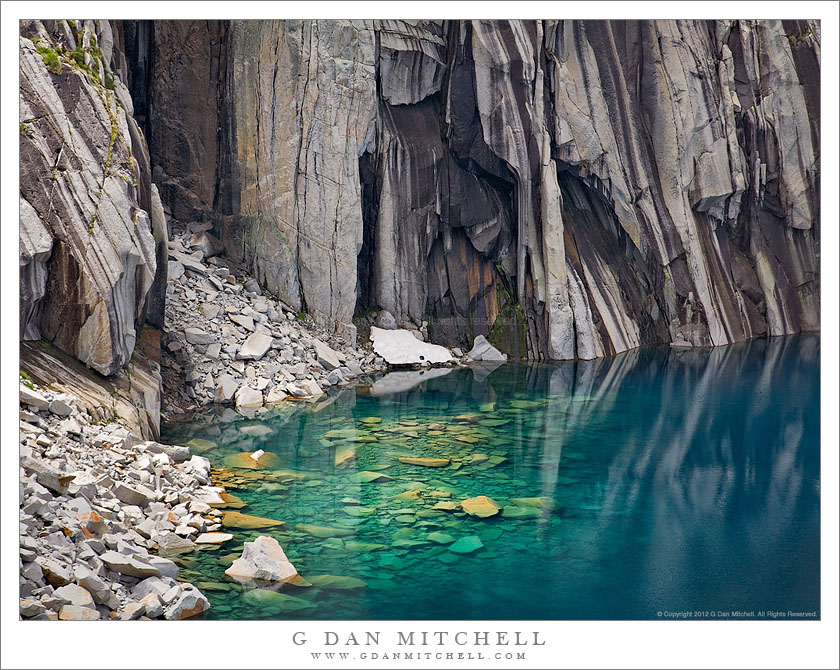
Submerged Boulders, Lake, and Cliffs. Sequoia National Park, California. August 6, 2008. © Copyright G Dan Mitchell – all rights reserved.
I have backpacked in California’s Sierra Nevada range for quite a few decades. A number (a large number!) of years ago my wife and I went on a two-week trans-Sierra backpack trip that traversed the range from west to east between Crescent Meadow and Whitney Portal, following a route known as the “High Sierra Trail.” On the third morning we left our camp and began the stiff ascent toward the pass we had to cross to enter the Kern River drainage. Near the top of the steepest part of the climb the trail momentarily leveled out and we found ourselves facing a high, rockbound lake with a perfectly vertical patterned rock face dropping straight into the water on the far side. The view seemed familiar – and I realized that it was a scene captured by Ansel Adams (“Frozen Lake and Cliffs“) in the early 1930s. (I also later realized that there is a wonderful and well-known photograph of the subject by Vern Clevenger.)
My wife and I were enthusiastic about photography in those days, too, and we carried a couple of Pentax SLRs and a few lenses and many rolls of film into the back-country. But I don’t think I came back with more than a few “snapshots” of this lake on that trip.
Fast-forward a few decades to 2008 when a group of my backpacking friends decided to follow this same trans-Sierra route — and, of course, I had to join them. Once again, I found myself ascending the trail toward that small bowl, but this time I had a plan to photograph the lake and the equipment to do it right. I recalled parts of the climb from my previous trip, but I had probably forgotten more than I remembered during the intervening decades. As the trail traverses a beautiful wet section full of wildflowers (which I had forgotten) I could tell that the lake was just ahead, and soon I topped a small saddle and saw the familiar scene before me.
As planned, I set to work doing some of the photography that I had contemplated before the trip. To be honest, I mainly worked from more or less the location that Adams must have used, though the conditions were a bit different on this day – the light was changeable as broken clouds passed above, and there was very little snow, much less ice, left at the lake. After perhaps 30 or 45 minutes of work, my hiking partners were getting restless and it was time to move on. I felt that I had worked this scene about as much as possible under the circumstances – and I did get a photograph of the “classic view” that I like a great deal — so I loaded up my heavy 9-day backpack load, put away the camera, and strapped the tripod to the outside of the pack. I hoisted the load and slowly started up the switchbacks immediately above the lake.
A couple of switchbacks up the trail I happened to look back at the lake from a slightly higher vantage point, and from here the astonishing deep blue color of the lake and the apron of rocks falling into the water became visible. My first reaction was a combination of “Wow!” and “No way am I taking this pack off and setting all that stuff up again!” Fortunately, I’ve learned to give in to the former more than the latter — you never know if you’ll see certain sights again — so I dropped the pack and set up the tripod, framed a composition and made a few exposures as the broken clouds scattered varying kinds of light across the scene. (For those who imagine that landscape photography is always a slow and contemplative process and that it always results from careful pre-planning and pre-visualization… baloney! Sometimes it requires quick and almost intuitive action and a certain amount of good luck. )
Now step forward a few more years. Like many of us, I had been coming up to speed for several years with the new media of digital cameras and inkjet printing. I was “getting it” with the camera and the exposure side of the process. But while I was producing prints that were fine, I realized that there things that I still needed to understand better if I wanted to make inkjet prints from digital images that would really be special. I did a lot of reading and experimenting, both of which are usually effective ways for me to learn, but I began to think about other ways I might more quickly make progress.
As luck would have it, my wife and I have some “history” with one of the finest photographers and printers using digital photographic media today, Charles Cramer, and we are fortunate to be able to call Charlie a friend. (Believe it or not, Charlie played organ at our wedding!) As I recall it now, I decided to contact Charlie and ask for some advice about how to proceed — perhaps a workshop would be useful or maybe he would recommend enrolling in a class somewhere. What Charlie said, essentially, was “Come on over and bring some files and I’ll look at them with you.” Lucky me!
I arrived with a few files that I thought might be interesting to work with. Charlie took a look and, unexpectedly, decided that we would work on this one. Charlie, as the generous person I know him to be, essentially gave me a four-hour personal workshop on my photograph and how to move it toward a more effective print. I won’t go into all of the details of what I learned, but aside from a starting to pick up a new repertoire of techniques to apply to my photographs, I learned a more important lesson that I have encapsulated into a motto: “let the light in.” Basically, he showed me how to go from images that now seem, in retrospect, to be dim and murky (though I perhaps thought they were “dramatic and moody” at the time) to prints that seem more full of light – I don’t know quite how to describe it in any other way. So this photograph became a sort of watershed in my continuously-evolving process of understanding how to move the photograph more effectively towards a print. And for this, Charlie, I again say, “Thank you!”
(Hint: Charlie teaches workshops. Sign up early – they sell out, usually months in advance. Charlie is a great photographer, a great printer, a great teacher, and a great guy! He has my very highest recommendation!)
From time to time people ask me how to get to the site of the photograph, when it is best to shoot it, whether it always looks like this, and whether there are similar lakes in the Sierra. Let me take those questions in order.
This location is not technically difficult to get to, but it is a long walk and you must backpack – this is not a trip to take lightly, especially if you plan to do serious photography when you get there. The lake is a good distance in from a popular trailhead in Sequoia National Park. Strong backpackers might be able to get there and back in four days, but photographers probably will take more time. At this point, I have a vague idea of going back here and setting up a bivy camp right near the lake, perhaps by late morning on day three, then exploring the area more thoroughly for the rest of the day. I’d get up the next morning and photograph it (and some surrounding areas) again before heading out. This sounds like at least a one-week backpacking trip!
There are two parts to the answer to the “when” question, time of year and time of day – and the answers really relate more to a general awareness of the cycles of time of day and season than to something specific to this place. The first time I visited was close to the end of August in a relatively wet year and the second was near the beginning of August in a drier season. If you are interested in water and wildflowers, when photographing in such places I would aim more for the earlier date than the later one. You may pay a price in mosquito bites, but you’ll see more wildflowers along the way — there is an direct relationship between number of mosquitos and number of wildflowers in alpine photography! — and there is more likely to still be a bit of snow around. Both times that I’ve been there I arrived around mid-morning. In many situations this might not be an ideal hour for photography, but at this lake I’ve found it to be a good time to shoot. Because there are high peaks above the lake the light still seems fine for shooting this late in the day – and much earlier in the day you would not get the light shining into the water and diffusing over the rocks. I’ve never been there after about noon, though I wonder what might happen later in the day. The surrounding area is somewhat open to light from the west, so it is possible that evening light could be interesting. (Excuse enough, perhaps, for the return trip I described in the previous paragraph?)
Of course, it was my good fortune to arrive on a day when broken clouds scattered fast-moving patches of light and shadow across the landscape, often softening the light and illuminating shaded areas. You really cannot count on that sort of light in the Sierra, where you’ll more often encounter extended periods of boringly perfect cloud-free weather. And, when you come right down to it, virtually none of this advice is specific to this one place – these are general observations about light and exposure and so forth that apply anywhere in the Sierra.
As to the question of whether there are similar Sierra lakes, they would need to be very high, surrounded on several sides by very high and steep rock walls, be deep and still enough to produce the deep blue coloration, and have the loose rocks spilling into the lake in just the right spot. I’ll bet that someone can think of a lake that reminds them of this… and what could be more rewarding than searching for such a thing? It is my view that each Sierra lake has its own “personality,” and I’m more interested in discovering the unique qualities of each. (In case you are set on going to “this” lake… keep in mind that there are thousands of worthy lakes in the Sierra and at each one it is possible to make photographs of compelling beauty. The specific lake isn’t the point. In fact, it could well be more fun and rewarding to find your own beautiful lake among the scores of them all over the range!)
Notes: This photograph has been edited since it was originally posted and the title of the photograph is now slightly different from the title I originally used.
The Photograph Exposed series:
- A Photograph Exposed: “Submerged Boulders, Lake, and Cliffs” (2010)
- A Photograph Exposed: A Tale of Light (2011)
- A Photograph Exposed: Photography and Luck (2012)
- A Photograph Exposed: “San Francisco Skyline — Winter Fog and Haze” (2015)
- A Photograph Exposed: “Two Rocks, Morning, Racetrack Playa” (2015)
- A Photograph Exposed: “Two Islands, Fog” (2015)
- A Photograph Exposed: “Shoreline Reflections, Trees and Rocks” (2015)
- A Photograph Exposed: One Subject, Two Compositions (2015)
- A Photograph Exposed: Technique and Interpretation in Post (2015)
- A Photograph Exposed: Je Suis Bleu (2022)
 G Dan Mitchell is a California photographer and visual opportunist. Blog | About | Flickr | Twitter | Facebook | Google+ | 500px.com | LinkedIn | Email
All media © Copyright G Dan Mitchell or others where indicated. Any use requires advance permission from G Dan Mitchell.
You learned your lesson well! Brilliant image :-)
Thanks, Ernie – you would know since you were there… waiting… and waiting… and waiting for me to put the darn camera down and get on with it! :-)
This version of the image was optimized for print and, as such, it looks a bit brighter on the web than the print is.
Dan
Whatever you did with Charlie worked! Quite well in fact – my first thought when I saw this photo was that it was quite a bit brighter than I remembered. It is a beautiful place and you’ve captured it so well!