
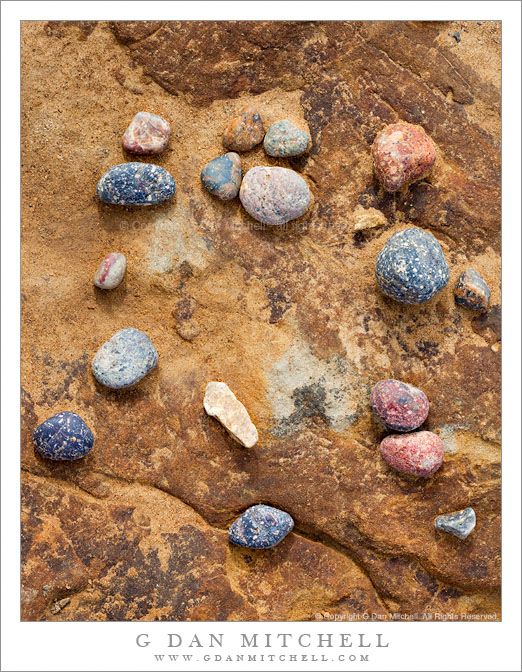
Colorful Pebbles, Weston Cove

Colorful Pebbles, Weston Cove

Colorful Pebbles, Weston Cove. Point Lobos State Reserve, California. October 23, 2010. © Copyright G Dan Mitchell – all rights reserved.

Colorful pebbles washed up near the water line at Weston Cove, Point Lobos.

This is another “wandering around on the beach with my eyes open” photograph, made at Weston Cove at Point Lobos. This little circular cove has a pebble beach so there are lots of small pebbles of all colors and shapes along the edge of the water. As I wander about this spot I find the pebbles fascinating, both visually and for the sound they make as they are dragged back toward the sea by the retreating waves. While there are pebbles everywhere – in every small hollow or crack, at the surf’s edge, even further up the “beach” where they were left by higher tides and storms – interesting juxtapositions of the pebbles are a bit harder to find. I was fascinated by this little collection, both because of the linear and curving relationships between their positions and because of the very different and colorful types of rock against the background of sandstone.

This photograph is not in the public domain and may not be used on websites, blogs, or in other media without advance permission from G Dan Mitchell.

G Dan Mitchell Photography | Twitter | Friendfeed | Facebook | Facebook Fan Page | Email

Kelp and Rock, Weston Cove

Kelp and Rock, Weston Cove

Kelp and Rock, Weston Cove. Point Lobos State Reserve, California. October 23, 2010. © Copyright G Dan Mitchell – all rights reserved.

Dried kelp on rocks near the surf line at Weston Cove, Point Lobos.

On this late-October Saturday I traveled to the Monterey Peninsula for the opening of Charlie Cramer’s ‘Earth, Water, Light’ show and lecture at the Center for Photographic Art in Carmel. (You should go if you are in the area! The show runs from now through the end of the year and perhaps a week or so beyond.) With a winter-season Pacific storm coming in I wasn’t certain of what to expect from the weather, but ended up shooting in some wonderful light at Point Lobos.

There are many subjects to shoot there, and the light is one of the main factors (along with the season, the time of day, and random inclinations…) determining the subjects I’ll focus on. With the edge of the high clouds from the approaching storm diffusing the light it seemed like a good opportunity to shoot the rocks and kelp and other subjects along the shore line. When I shoot these subjects, especially in and around Point Lobos, I often have to slow down and just wander and look before I can really see the possibilities. A quick glance more or less gets me no farther than, “Look! Kelp! And rocks!” But if I wander around slowly and look carefully I’ll usually find some things of special interest among the piles of stones and kelp and other stuff that washes up. I often seen the thick tubular kelp forms like the one at the bottom of this frame, but seeing it with the more delicate material still attached – much less spread out this way on the rocks – is unusual, so I spent some time working with this subject.

This photograph is not in the public domain and may not be used on websites, blogs, or in other media without advance permission from G Dan Mitchell.

G Dan Mitchell Photography | Twitter | Friendfeed | Facebook | Facebook Fan Page | Email
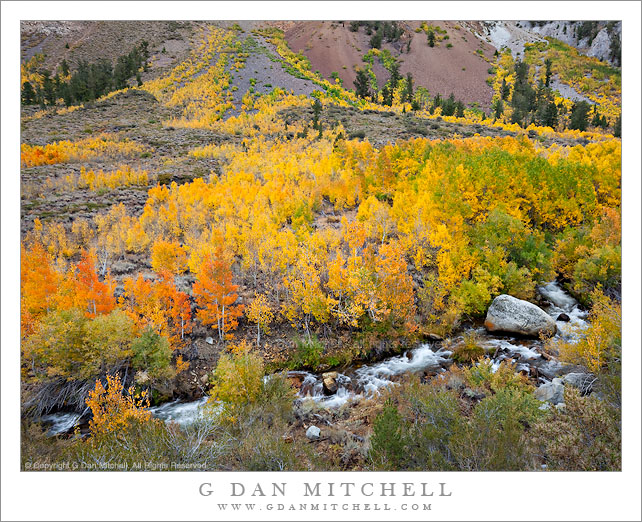
Aspen Grove, South Fork, Bishop Creek

Aspen Grove, South Fork, Bishop Creek

Aspen Grove, South Fork, Bishop Creek. Sierra Nevada, California. October 2. 2010. © Copyright G Dan Mitchell – all rights reserved.

Brilliantly colorful fall aspens along the south fork of Bishop Creek.

I have been in this area many times in the past to search for aspens – and to backpack – but when I came into this part of the canyon this year I think I exclaimed, “Oh my God!” out loud, the colors were so intense and so widespread. While the trees in the lower portions of this watershed were still largely green, the colors in the upper canyon had gone fluorescent when I arrived – mostly brilliant yellow-gold with some orange and red, and stretching from the stream-side to the highest reaches of vegetation on the slopes above. I know that people from New England cannot imagine that aspen color displays can compete with their colors – and they are usually probably right – but this year I think they might have exclaimed as I did if they had seen this canyon.

This photograph is not in the public domain and may not be used on websites, blogs, or in other media without advance permission from G Dan Mitchell.

G Dan Mitchell Photography | Twitter | Friendfeed | Facebook | Facebook Fan Page | Email

Photographic Myths and Platitudes – ‘Landscape Photography Lenses’ (Part I)

(NOTES: This article has been updated periodically since its original publication, including a more significant update in 2019. And, yes, there is a Part II.)

A recent discussion got me thinking once again about another “myth” of landscape photography, namely that some lenses are appropriate for landscape photography and other lenses are not. There are several such myths, including but not limited to the following aspects: focal lengths, zooms versus primes, maximum apertures, expense, etc. While I could have a lot of fun (or not!) starting with the zoom/prime question, I have saved that for Part II. (Short preview: I think that “zooms or primes?” may be the wrong question, the image quality implications are not as simple as you might think, and I use both… but tend more and more to rely on zooms.)

Instead, I’ll start with…

Focal Length

The trigger for this was a discussion of the suitability of a certain type of lens for landscape photography. I had made a point concerning a 85mm prime that I sometimes used, and the other party disagreed with my perspective. Several rebuttals to my thinking were offered, but the one offered as a sort of trump card was that using a 85mm lens for landscape is an inappropriate choice, and one should use a wide-angle zoom like a 16-35mm lens.

While many landscape photographers know better, especially those who have done this for a while, it is surprising how many assume it to be accepted wisdom that proper landscape photography is done with ultra-wide to perhaps normal focal length lenses, and that the first and perhaps only lens that a landscape photographer would want would be such a lens. (Again, I’m not getting into the prime v. zoom question here – I’ll save that fun topic for a later post. :-)

In my view, the best answer to the what focal length is best for landscape?” question is the focal length that works best for the photograph I am making right now. My current kit, based on full frame DSLR bodies, covers focal lengths from 16mm to 400mm — technically 560mm if I add a 1.4x TC. While I sometimes work with less than the full kit (when backpacking, for example), when I’m not constrained by weight or other limitations I carry lenses to cover this full range and typically use most or all of them. What follows is an overview of some of the lenses I use, accompanied by some photographic examples and explanations.

Continue reading Photographic Myths and Platitudes – ‘Landscape Photography Lenses’ (Part I)