
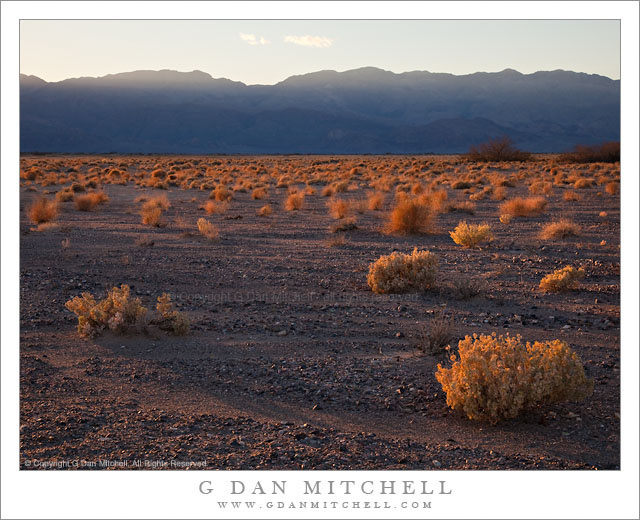
Last Light on Desert Plants, Death Valley

Last Light on Desert Plants, Death Valley

Last Light on Desert Plants, Death Valley. Death Valley National Park, California. February 20, 2011. © Copyright G Dan Mitchell – all rights reserved.

The last light of a winter day lights the plants at the edge of a wash in Death Valley National Park, California.

On this afternoon I drove a bit up the east side of the Valley past the turnoff to Beatty looking for subjects to shoot along the hills that parallel the valley. I did not initially have a specific shot in mind, since this isn’t an area that I know very well – I’ve mostly driven past it on my way to some other place. I was generally thinking of a couple of possibilities. One was an early evening photograph looking up into one of the very large canyons, probably include the massive washes that spill out of them and aiming for a very rugged looking image. I looked for a few such places and played around a bit with the idea of shooting one or two, but it wasn’t quite working for me.

I have included some low hills along this area called, I believe, the Kit Fox Hills, in some photographs that I have made of this area from way over near Mesquite Dunes. These hills which sit just above the road toward Scotty’s Castle have intrigued me, so I had also looked at them. As I passed them earlier in the afternoon I made a mental note to come back and check out one particular spot in better light, and when the canyon idea didn’t seem to work out I decided to head back there. I was probably a bit late in settling on this subject, but I arrived while the sun was still (just barely) above the tops of the ridges on the opposite side of the Valley. I grabbed equipment and went to a spot where I thought I could use a particular mesquite plant as foreground to a shot of these low hills, but then this backlit expanse of the floor of the Valley filled with these small, rugged plants caught my attention. I decide to photograph them before turning my attention back to the mesquite and hills. As I shot a few frames the sun began to drop behind the far hills much sooner than I expected, and this was close to the last photograph I made before I was in shadow.

All seriousness aside, someone just suggested that an alternate title for this photograph might be “Sea of Tribbles!” ;-)

G Dan Mitchell Photography | Flickr | Twitter | Facebook | Email
Text, photographs, and other media are © Copyright G Dan Mitchell (or others when indicated) and are not in the public domain and may not be used on websites, blogs, or in other media without advance permission from G Dan Mitchell.

The Economics of DSLR “Protective” Filters

The subject of whether or not to get so-called “protective” UV filters for DSLR lenses comes up a lot. I used to respond to the question frequently – so frequently that I eventually gave up and just wrote a post on the subject that I could refer people to when they ask.

However, during a recent weak moment I wrote a new response to the notion that ‘protective’ filters provide good value for all photographers. As I do from time to time, I’m sharing it here:

Someone wrote: … would you rather pay $150 on a filter that *might* compromise your shot or spend $150 on replacing the front element and have *no* possible risk of image degradation from the extra piece of glass?

I replied: This is essentially an insurance question. Obviously, if we knew that our lens would certainly be destroyed in a way that was 100% preventable by using a filter we would almost certainly get a filter. But that is an imaginary scenario that is far from reality.

Most lenses will never be damaged in any serious way. My hunch is that this is actually the fate of a very small percentage of lenses – probably far less than 10%, and I would bet closer to 1%.

Of those that are damaged, only some will suffer a blow to the front element. There are many other modes of failure – a dropped lens that breaks the mechanism, something crashing into the side of the lens, water damage, etc.

Of those that suffer a blow to the front of the lens structure, only some will result in contact with the front element. Of those in which contact with the front element occurs, some would not cause any damage or any significant damage. Some would damage the front element, but would be violent enough that the filter would not have prevented the damage. A few that might not have damaged the front element will send glass shards from the broken filter into the front element and damage it. In some subset of cases, all of the variables might line up just right and prevent damage.

At this point the user would have to replace the broken high quality filter at a cost that varies depending on a number of factors. Let’s use a figure if $100 for an expensive L zoom. The owner has now invested something on the order of $200… which is not much different from the cost of replacing a front element, as I understand it.

In terms of the probability of damage, the cost of the filter, the likelihood that the filter would save the day… the filter is probably one of the worst insurance investments you could make.

Am I unalterably and completely opposed to the use of ‘protective’ filters? Almost, but not quite. While I do not think that it makes sense to automatically stick such a filter on every lens for general use – see the link above for more on this topic – I can think of one sort of situation in which I might use one. I would consider a filter if I were shooting a sealed-body camera (such as a Canon 1-series) and was working in conditions that were truly dangerous to my equipment (and not just a bit of mist or ocean spray) and I was using of the small number of L lenses that become sealed (and not all do) with the addition of a filter.

Other than that? No.

G Dan Mitchell Photography | Flickr | Twitter | Facebook | Email
Text, photographs, and other media are © Copyright G Dan Mitchell (or others when indicated) and are not in the public domain and may not be used on websites, blogs, or in other media without advance permission from G Dan Mitchell.

Rushing Water and Granite Slab, Sierra Nevada

Rushing Water and Granite Slab, Sierra Nevada

Rushing Water and Granite Slab, Sierra Nevada. Yosemite National Park, California. June 28, 2010. © Copyright G Dan Mitchell – all rights reserved.

A Sierra Nevada creek, swollen from spring runoff, flows across granite slabs – Yosemite National Park.

The image and sound of spring runoff water rushing over granite slabs are common in the high Sierra. Though the scene is almost a generic one, for me it also brings to mind many very specific places and experiences throughout the range. (Some of my backpacking friends might think of a spot along Tyndall Creek on the John Muir Trail where we have camped more than once.)

The exact location of this little bit of cascading and rushing water is probably not very important – you are never far from a little scene like this if you are near almost any little creek high in the Sierra! Here the water flows mostly across very smooth rock – so smooth that you can see right through the rushing water to the rocks in many places. In this precise spot there is a weakness in the rock and a small ledge has formed, and the result is a bit of white water.

I’ll share a few technical observations about this photograph, too. First, there isn’t a sharp thing in the image! While sharp focus can be important, I don’t think it is here. (Though if you look closely, the patterns of the blurred, fast-moving water are sharp in a fuzzy sort of way. ;-) The rocks beneath the water cannot be sharp because they are blurred by the water; the water cannot be sharp since I intentionally chose a shutter speed that allowed motion blur. Second, I have to admit that I did not originally have a black and white photograph in mind when I made this exposure. I worked on it for a while in color and though I liked the motion of the water I just wasn’t happy with the coloration of the scene. I finally realized that this image wasn’t about the “reality” of the rocks and water but about creating an impression of the rushing water – and that perhaps monochrome might work. Third, this is yet another “landscape” photograph made with a lens that the “common wisdom” (which often turns out to be not so wise) would say is not a landscape lens – a 70-200mm zoom.

G Dan Mitchell Photography | Flickr | Twitter | Facebook | Email
Text, photographs, and other media are © Copyright G Dan Mitchell (or others when indicated) and are not in the public domain and may not be used on websites, blogs, or in other media without advance permission from G Dan Mitchell.

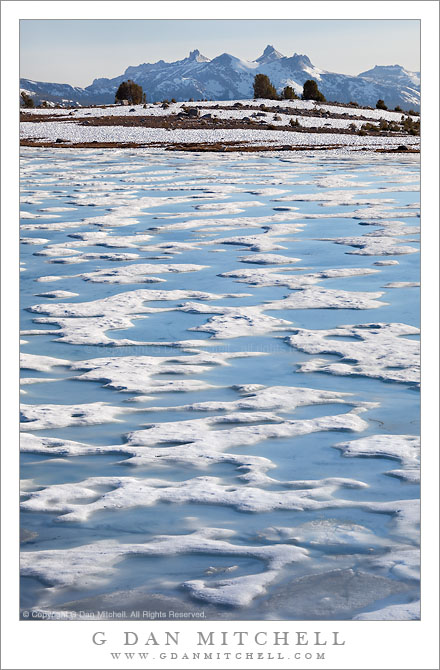
Melting Ice, Gaylor Lake and the Cathedral Range

Melting Ice, Gaylor Lake and the Cathedral Range

Melting Ice, Gaylor Lake and the Cathedral Range. Yosemite National Park, California. June 29, 2010. © Copyright G Dan Mitchell – all rights reserved.

The distant Cathedral Range rises above the melting ice of Gaylor Lake, Yosemite National Park.

Near the end of June last summer I hiked up here late in the day with my friends Mike and Karl. This was a somewhat unusual season in the Yosemite Sierra, in that there had been a lot of snow during the winter season and it had continued right on into spring. Consequently, the high passes opened up later than usual, and on a very late June day when things would typically be a bit more summer-ish, it looked more like late winter up here when we arrived.

I’ve visited this place quite a few times, but had never seen quite this scene before. More typically, the snow and ice are completely gone by the time I manage to get up there, and a typical visit usually entails arriving late on a warm afternoon and then hanging out in the sun while waiting for the evening light to come on. This time we were in snow before we crossed the ridge before the lake, and we had to think a bit about just how to head down toward the lake since the usual path was covered in snow. The lake itself was (obviously, judging from the photo!) still covered in ice, though melting was underway and the surface was a jigsaw puzzle of alternating blue pools and white ice.

We found a location near clumps of trees on rocky talus slopes above the lake to do our photography. In this photograph I shot down the length of the lake to mostly fill the frame with the melting ice. Beyond a small rocky rise at the end of the lake, the terrain drops off towards the meadows of the Tuolumne region, and beyond rise the peaks of the Cathedral range in early evening light.

G Dan Mitchell Photography | Flickr | Twitter | Facebook | Email
Text, photographs, and other media are © Copyright G Dan Mitchell (or others when indicated) and are not in the public domain and may not be used on websites, blogs, or in other media without advance permission from G Dan Mitchell.