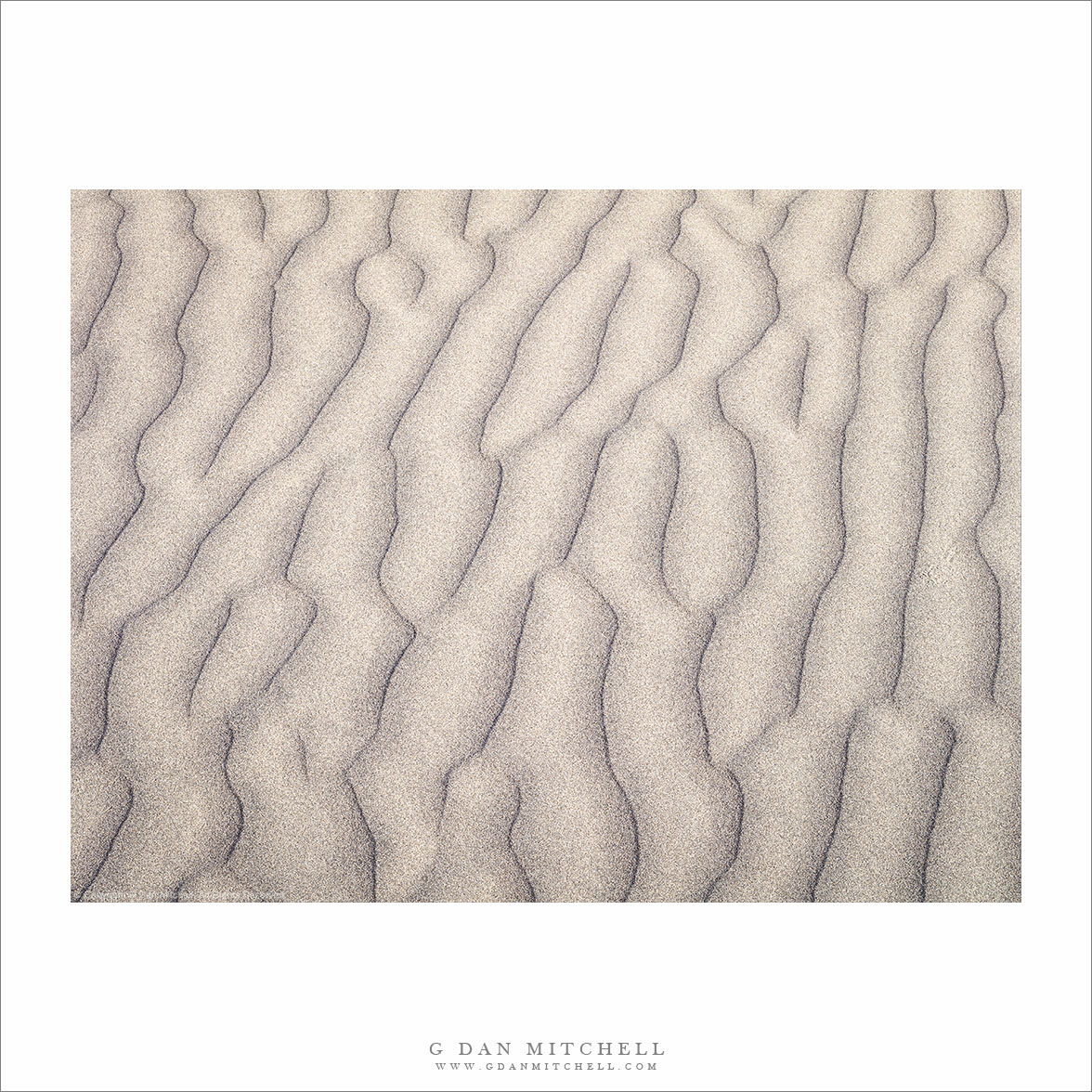
“Aeolian Bedforms” — Wind-caused ripples in desert sand dunes, Death Valley.
This is probably the classic notion of what a desert looks like — fields of wind-formed sand dunes stretching into the distance. In truth, such dunes typically cover only a very small fraction of the desert landscape. That’s certainly true in Death Valley National Park, where large, impressive dunes are only found in a handful of locations. We visited one of them on the final morning of our late February trip.
“Sand Patterns” — Patterns in sand dunes, Death Valley National Park.
Our main photographic targets during our late-February trip to Death Valley were Lake Manly and the impressive wildflower bloom, but we did schedule one morning visit to the sand dunes. We arrived well before sunrise when it was too dark to see our way into the dunes. Unfortunately, this was not to be a morning for grand dune photographs, since morning overcast blocked the sunlight. So instead we focused on small subjects — plants and flowers, the morning traces of the passage of wildlife, and textures of windblown sand.
I’ll break with the tradition of the these posts and write a bit about a technical photographic topic. A challenge of photographing the sand is that, unless you photograph straight down or find a suitably slanted bit of sand, depth of field can be a challenge. I sometimes employ a solution that surprisingly few photographers seem to use. I have a tilt/shift lens adapter for my landscape camera that lets me attach a medium format zoom lens and use the adapter’s movements to angle the pane of focus to match the surface of the dunes. That’s right — movements with a zoom lens!
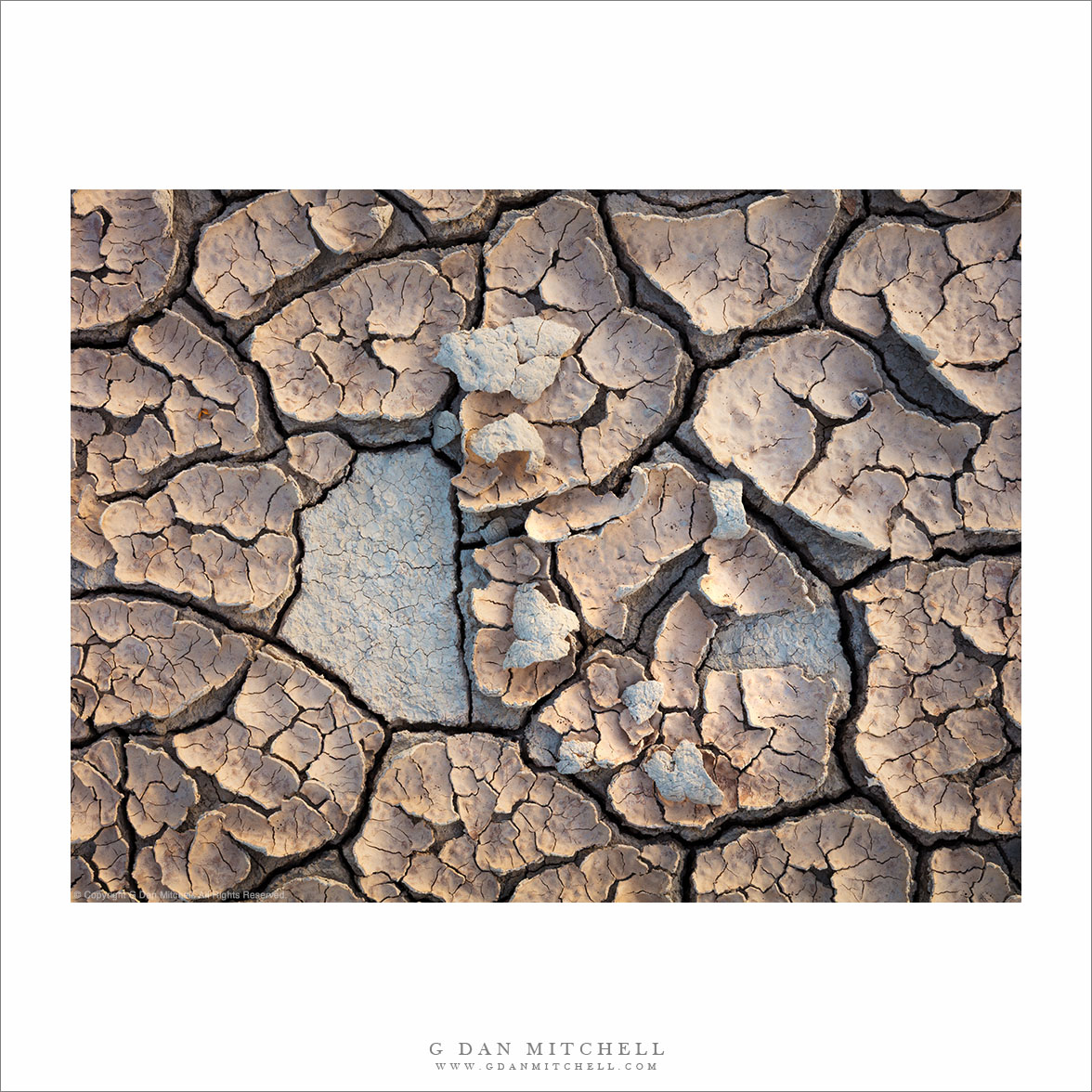
“Displacement” — Cracked and broken dry desert mud, Death Valley.
Those who photograph in the desert inevitably end up photographing… mud. I was attracted to many things in this little scene. The fractal patterns themselves, are always fascinating. (Finding just the right patterns is more difficult than it should be!) In this case I also liked the disruption of the expected pattern by the displacement of material from one of the dried cakes of mud. It appears that something has broken the top layer, left shards to the right, and interrupted the overall coloration of the little scene.
I cannot quite say why it is that photographers are so interested in desert mud — but we definitely are. There is something about the patterns themselves, but also the way light plays across these textures. I recall one time walking down an Utah canyon with a half dozen photographer friends. We encountered a little patch of nearly dry mud, and our progress immediately halted as all of us unloaded packs, set up tripods, and went to work for the next half hour… photographing mud.
“Shadows, Ponte Dei Carmini” — Light and shadows on buildings at the Ponte Dei Carmini, Venice.
This photograph from Venice embodies many of the features that I expect to see in that part of the world. The Southern European light? Yes. Wrought iron work? Check. Earth tone colors on the buildings? Indeed. Narrow walkways? For sure. Of course, the venetian-style canals — not visible in this photo — are not quite so ubiquitous.
I’ll share a little technical note about this photograph. Cameras cannot really produce a native image that shows us details in both the very bright highlights (direct sunlight) and deep shadows. (Our eyes deal with this by quickly adapting to the brightness at the center of our attention.) So with digital photography our first priority is to protect those bright highlights — let them get out of control and you’ll lose highlight details completely. The subsequent post-processing task is then to brighten details in the shadows to restore what we think we saw when we looked at the scene. The trick is to do that in a manner that doesn’t give it away, one that doesn’t make the technique too obvious
Leave a comment or question using the form. (If you are reading this on the home page, click the article title to see the full article and the comment form.
Photographer and visual opportunist. Daily photos since 2005, plus articles, reviews, news, and ideas.
Manage Consent
To provide the best experiences, we use technologies like cookies to store and/or access device information. Consenting to these technologies will allow us to process data such as browsing behavior or unique IDs on this site. Not consenting or withdrawing consent, may adversely affect certain features and functions.
Functional
Always active
The technical storage or access is strictly necessary for the legitimate purpose of enabling the use of a specific service explicitly requested by the subscriber or user, or for the sole purpose of carrying out the transmission of a communication over an electronic communications network.
Preferences
The technical storage or access is necessary for the legitimate purpose of storing preferences that are not requested by the subscriber or user.
Statistics
The technical storage or access that is used exclusively for statistical purposes.The technical storage or access that is used exclusively for anonymous statistical purposes. Without a subpoena, voluntary compliance on the part of your Internet Service Provider, or additional records from a third party, information stored or retrieved for this purpose alone cannot usually be used to identify you.
Marketing
The technical storage or access is required to create user profiles to send advertising, or to track the user on a website or across several websites for similar marketing purposes.