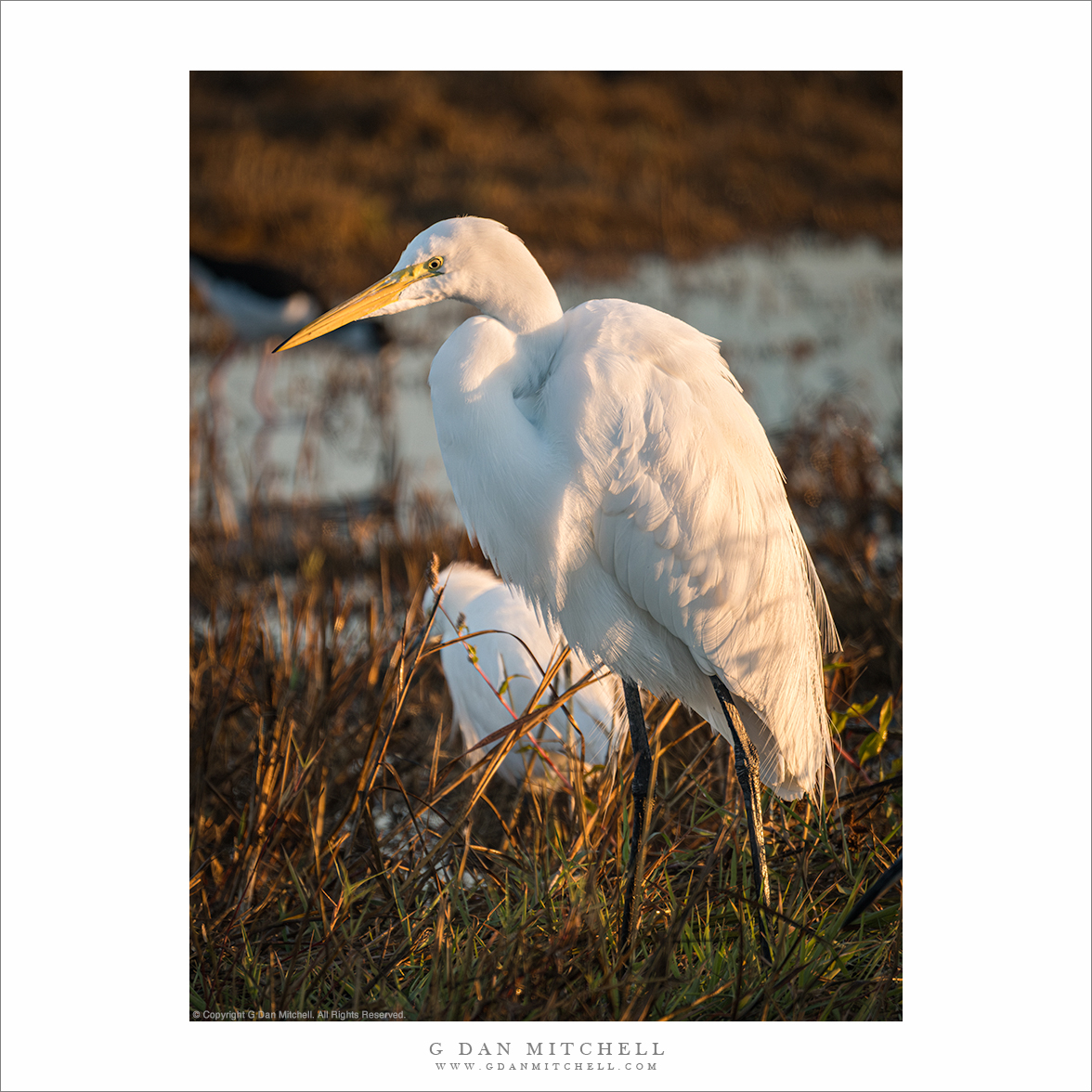
“Egret and Chick, Evening” — A great egret, accompanied by an egret chick, stands in evening light.
Near the end of October last year, while returning from a fall color visit to the Western Sierra Nevada, I decided to make a stop at a Central Valley location where I have photographed migratory birds in the past. I wasn’t expecting to find the winter birds that I usually see there, but I was surprised to find large numbers of other birds that usually diminish at this spot later in the season. Among them were large groups of great egrets.
“Panamint Valley” — View across Rainbow Canyon toward the flats of Panamint Valley.
Death Valley National Park is a huge landscape, in more ways that one. The park is huge. It is the largest park in the contiguous states. (Alaska, where everything is on a larger scale, has four larger parks.) Within the park we often are able to view huge distances — in fact, Death Valley’s visual scale reminds me of places I’ve seen in Alaska. Here we look down Rainbow Canyon and across the entire Panamint Valley (one valley west of Death Valley itself) toward more desert mountains.
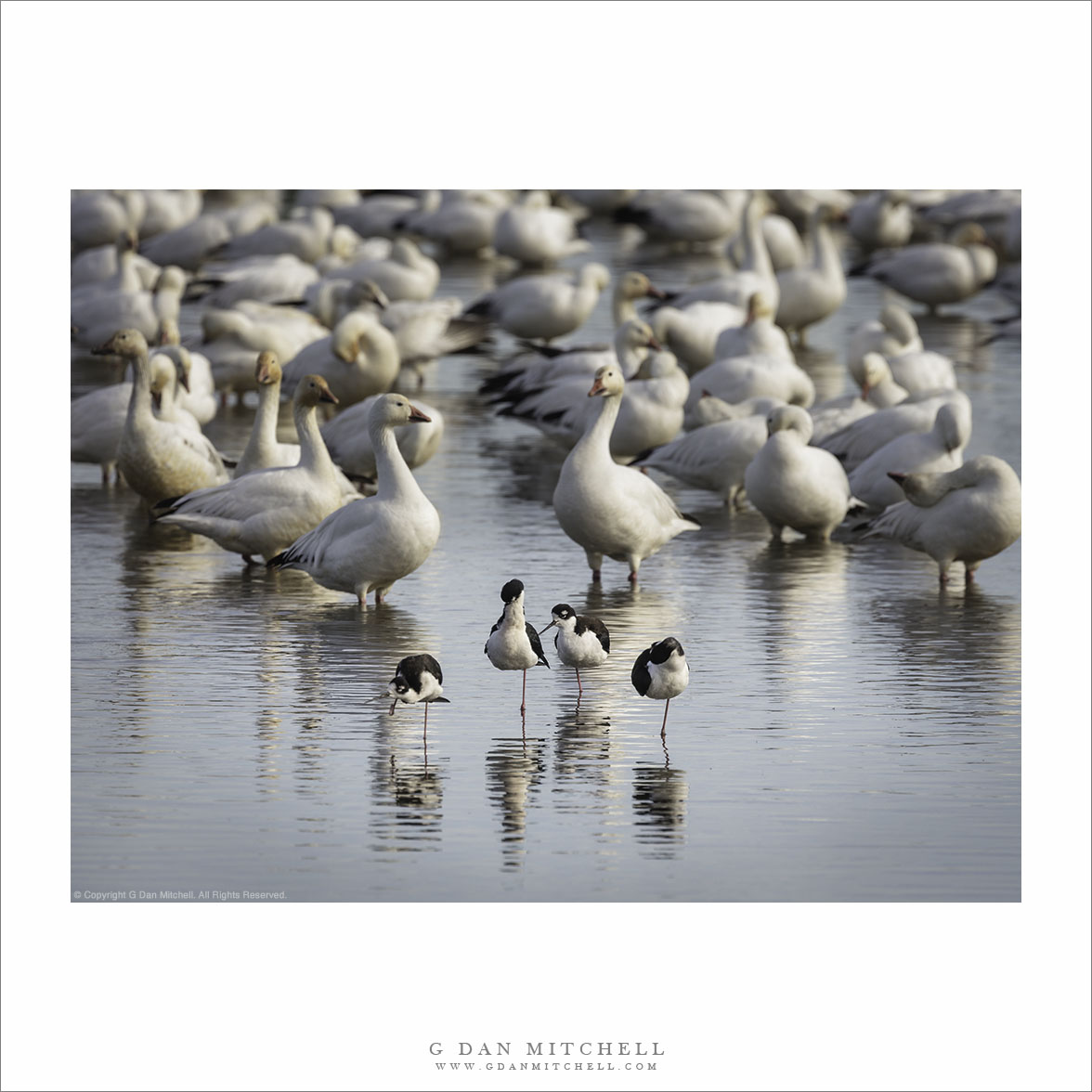
“Stilts and Geese” — Four black-necked stilts wade in front of a flock of snow geese.
This photograph comes from my second-to-last trip of the season to photograph migratory birds in California’s Central Valley. (See ya’ next year, geese!) Early in the season I try to time my visits for the best bird photography weather — a bit of morning fog, clearing later in the morning, and interesting clouds for sunset. But at this point, merely weeks before the geese would depart, I could not be as choosy!
“Wetland Island and Fog” — Tule fog mutes the wetland landscape beyond reed-covered islands.
Fog can make photography wonderful… or difficult when I photograph migratory birds in California’s Central Valley. There are practical issues, such as driving on roads that are dangerously obscured, or not being able to see the birds in the murk. It is cold and damp. But I love the atmosphere that tule fog brings to this landscape, and that’s why I keep going back.
I also like the way that it lets me “minimize” the landscape. Fog blanks out any subjects that are not close to the camera position. On a clear day you would see trees, possibly utility lines and poles, a sky with clouds, and who knows what else. But when the fog is thick all of those distractions disappear and I can work with the most minimal of materials.
Photographer and visual opportunist. Daily photos since 2005, plus articles, reviews, news, and ideas.
Manage Consent
To provide the best experiences, we use technologies like cookies to store and/or access device information. Consenting to these technologies will allow us to process data such as browsing behavior or unique IDs on this site. Not consenting or withdrawing consent, may adversely affect certain features and functions.
Functional
Always active
The technical storage or access is strictly necessary for the legitimate purpose of enabling the use of a specific service explicitly requested by the subscriber or user, or for the sole purpose of carrying out the transmission of a communication over an electronic communications network.
Preferences
The technical storage or access is necessary for the legitimate purpose of storing preferences that are not requested by the subscriber or user.
Statistics
The technical storage or access that is used exclusively for statistical purposes.The technical storage or access that is used exclusively for anonymous statistical purposes. Without a subpoena, voluntary compliance on the part of your Internet Service Provider, or additional records from a third party, information stored or retrieved for this purpose alone cannot usually be used to identify you.
Marketing
The technical storage or access is required to create user profiles to send advertising, or to track the user on a website or across several websites for similar marketing purposes.