
Earlier this weekend I read a forum thread about the Canon EF 50mm f/1.4 lens, of which I have a copy. The thread lamented the barrel distortion of this lens (which I don’t really find to be that big of an issue) and continued with posts suggesting alternatives including software correction in the post-processing phase. One response to this proposal was that software correction would degrade the image and would therefore be unacceptable.
That theory seemed sound and I have believed this to be true in the past, but I decided to test this idea for myself. Using an old photograph taken with this lens, I cropped a small section from one of the far corners – the worst part of the frame and, according to some, subject to a lot of softness and distortion on full-frame bodies like my Canon 5D. To make things a bit more challenging I used a photograph that included a bunch of dried california grasses – full of very fine details and high contrast.
I converted the original RAW file using ACR (Adobe Camera RAW) with no sharpening. In Photoshop I cropped to a section of reasonable size for web presentation, using that section from one of the corners of the image. Then I made a duplicate of the cropped section of the image.
In one of the two versions of the crop I used the LensfixCI plugin to correct for the slight barrel distortion of the EF 50mm f/1.4 lens. This $29 plugin* includes a database of many lenses, and also keeps a smaller databases of your lenses. It uses EXIF data to identify the lens (and focal length with zooms) used to take the photo and automatically applies optimum distortion corrections from its database. It takes me about 10 seconds to select the plugin and apply its changes.
* (I have left the reference to this plugin that I used when I did the test several years ago, even though I no longer use it. Today I simply use the built-in correction in Lightroom or ACR, where I apply lens- based corrections by default in virtually all cases.)
Next I used my normal sharpening methods on both images, inspecting the results and making adjustments as I applied them. In the end, as would typically be the case, I used slightly different sharpening settings for the two images – but that reflects the normal way of operating. Finally, I took the two images and placed them side by side in the single high quality jpg file that follows.
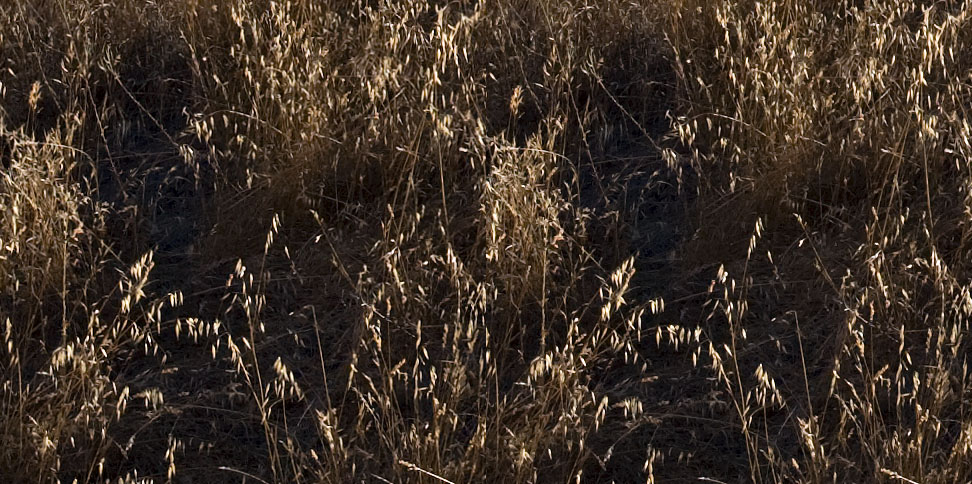
(NOTE: The version shown above on this page may have been downsized for formatting purposes, which limits the amount of detail that is visible. Click the image to view it at its original size, or follow this direct link to the original image.)
I have a darned hard time seeing any difference in sharpness, contrast, or color that might have been introduced by the correction process. If a difference is visible a) it is almost impossible to say which version is better, and b) the difference is almost certainly completely insignificant in an actual print. (Keep in mind that these are 100% crops of the worst part of the frame in the far corner – and that the area shown here would be a very tiny section of a full print that would be something like five feet/60″ wide.)
After doing this test, I’m not really concerned at all about any negative effects of using this method of correcting lens distortions, and today I simply allow ACR or Lightroom to automatically correct for such lens characteristics by default. And whatever the tiny negative effect on sharpness we might imagine to produce, it is far outweighed by the ability to straighten lines and so forth when necessary.
(Anyone care to guess which half contains the “corrected” version of the crop? Feel free to post a comment and an explanation of what you (think you) see… ;-)
(This 2007 post was slightly updated on 1/5/2013)
G Dan Mitchell is a California photographer and visual opportunist. His book, “California’s Fall Color: A Photographer’s Guide to Autumn in the Sierra” is available from Heyday Books and Amazon.
Blog | About | Flickr | Facebook | Email
Links to Articles, Sales and Licensing, my Sierra Nevada Fall Color book, Contact Information.
All media © Copyright G Dan Mitchell and others as indicated. Any use requires advance permission from G Dan Mitchell.